


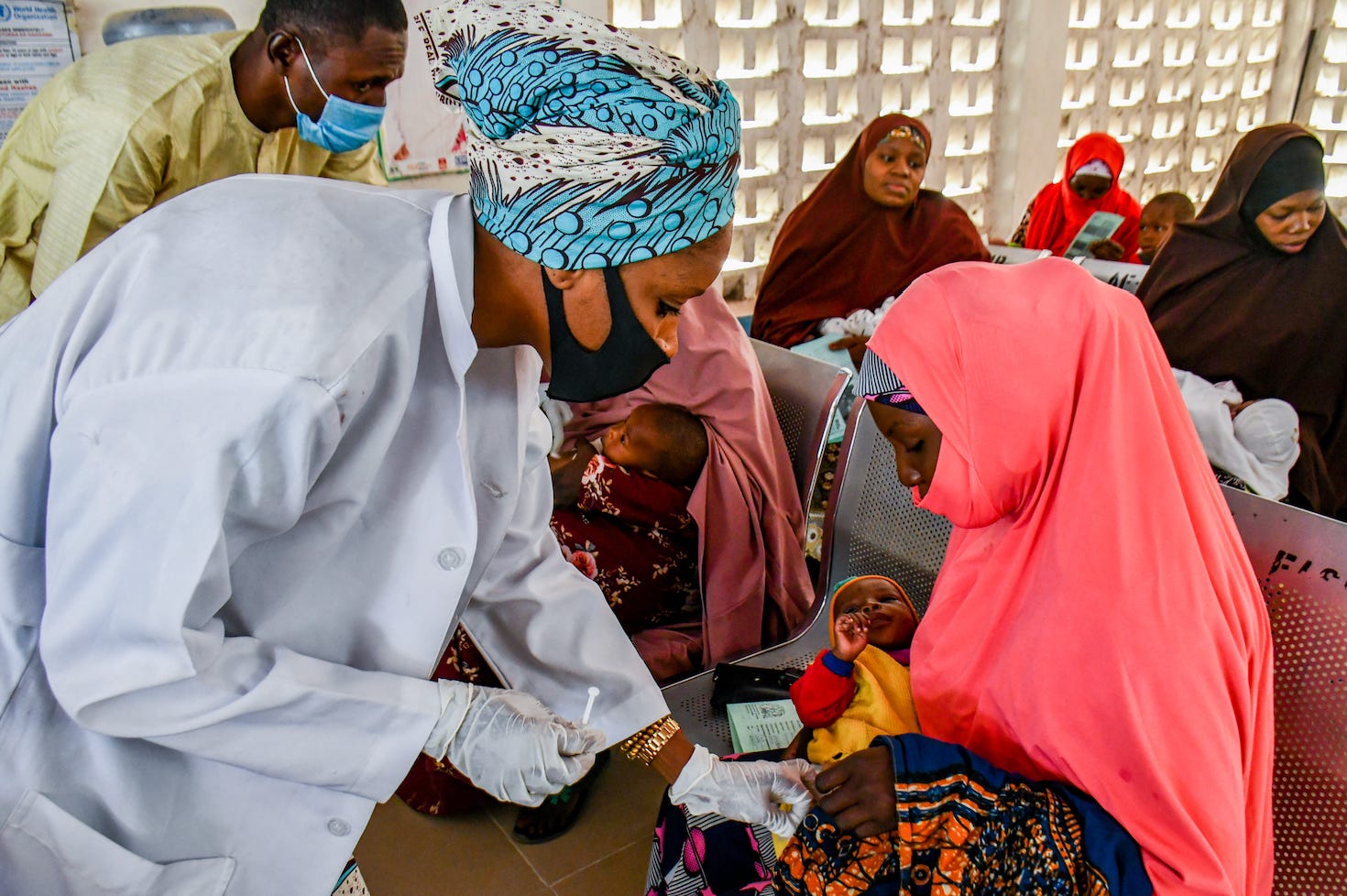
Many of our best surveillance tools today that were originally built to target specific diseases like polio and malaria have become critical infrastructure for outbreak response and early warning across a wide range of pathogens. This includes laboratory networks, diagnostic tools, and community health workers—all of which play vital roles in broader outbreak preparedness.
In today’s episode, two experts who have helped create platforms to monitor and respond to specific diseases explain how those systems have been leveraged to detect and respond to outbreaks of all kinds. Hamid Jafari served as Director of Polio Eradication for the World Health Organization’s Eastern Mediterranean Region, and Krystal Burungi Mwesiga is an entomologist at the Uganda Virus Research Institute, where she works as a research and outreach associate with the Target Malaria, a not-for-profit research consortium.
We kick off by discussing how these disease-specific surveillance platforms work, then broaden the conversation to how they’ve been adapted to respond to other outbreaks—and what can be done to make these tools even stronger.
This episode is produced in partnership with the United Nations Foundation as part of a series called “Before the Outbreak” that examines the role of disease surveillance in stopping the next pandemic. The episode is freely available across all podcast listening platforms, including Spotify and Apple Podcasts. You can also listen directly below.
Transcript edited for clarity
Krystal Birungi Mwesiga: The village health teams are on the ground, they are in the villages, and they’re the easiest form of keeping track and carrying out quick response to outbreaks in all the different areas of the country.
Mark Leon Goldberg: Welcome to Global Dispatches, a podcast for the foreign policy and global development communities and anyone who wants a deeper understanding of what is driving events in the world today. I’m your host, Mark Leon Goldberg. I am a veteran international affairs journalist and the editor of UN Dispatch. Enjoy the show.
Robust disease surveillance systems are the foundation of strong public health and essential to preventing, detecting, and responding to health threats before they escalate.
Many of our best surveillance tools today that were originally built to target specific diseases like polio and malaria have become critical infrastructure for outbreak response and early warning across a wide range of pathogens. This includes laboratory networks, diagnostic tools, and community health workers, all of which play vital roles in broader outbreak preparedness. In today’s episode, two experts who helped create platforms to monitor and respond to specific diseases explain how those systems have been leveraged to detect and respond to outbreaks of all kinds.
Hamid Jafari served as Director of Polio Eradication for the World Health Organization’s Eastern Mediterranean region, and Krystal Birungi Mwesiga is an entomologist at the Uganda Virus Research Institute, where she works as a research and outreach associate with Target Malaria — a non-profit research consortium. We kick off by discussing how these disease-specific surveillance platforms work, then broaden the conversation to how they’ve been adapted to respond to other outbreaks, and what can be done to make these tools even stronger.
Today’s episode is produced in partnership with the United Nations Foundation as part of a series called Before the Outbreak that examines the role of disease surveillance in stopping the next pandemic. Please visit globaldispatches.org to view other episodes in this series. And to note, the views and opinions expressed in this episode are those of the guests and the host and do not necessarily reflect the views of the podcast’s partners.
Now, here is my conversation with Hamid Jafari and Krystal Birungi Mwesiga.
Krystal and Hamid, thank you so much for joining me today.
Hamid Jafari: Thank you.
Krystal Birungi Mwesiga: Thank you so much.
Mark Leon Goldberg: So, I am joined by a polio expert and a malaria expert, but we are not here to talk about polio or malaria per se, rather how programs to monitor and respond to those two diseases have and may play a role in confronting new pathogens. Before we get there though, can I have each of you briefly discuss what malaria and polio surveillance and response looks like in practice? After all, these are very two different diseases. Krystal, let’s start with you. How do you track malaria cases on the ground? And can you share how this works in Uganda?
Krystal Birungi Mwesiga: Malaria remains the number one killer of children under the age of five in Uganda. So, it is definitely a national priority. And to make sure that we can keep track of the cases that we’ve got and all related infrastructure, we, in Uganda, have a couple of ways to do this. The first thing is Uganda has an electronic health management information system. So, this system is made up of two systems combined. So, the first thing is there is something called the mTrac. And the mTrac is a digital system that allows the collection of data from health facilities, but also from private clinics and drug shops using a simple SMS function, a short messaging system. So that means that different service providers can simply use their phones to send in messages concerning the malaria statistics or diagnostics that they have from their clinics. And all of this is integrated online onto a digital system. The second thing is the district health information system.
So, this targets specifically the healthcare facilities. So, every healthcare facility also digitally uploads all the data related to malaria from their facility on a weekly basis. So, together with the mTrac are what-make-up-dot electronic health management information system, and that allows the Ministry of Health to keep a weekly track of all cases happening and being reported within the country.
Mark Leon Goldberg: And correct me if I’m wrong. I mean, with malaria itself, you have like rapid diagnostic tests. So, presumably, a lot of the data being uploaded into these systems are, what, the results of these tests?
Krystal Birungi Mwesiga: Exactly. When individuals go into the health clinics with this complaint, they’re feeling sick, they’re not feeling well, the clinics or hospitals will do the malaria testing. So, they use the rapid diagnostic tests, and depending on the level of healthcare facility, the more advanced healthcare facilities will also do a microscopy test. So, they confirm the diagnosis with microscopy where they can actually see the parasites. That is due to resistance and a whole bunch of other things. But yes, so they do use the rapid tests in a lot of places.
And in the more advanced healthcare facilities, they do microscopy as well. And all of that data is reported on a weekly basis into this digital system. Aside from the healthcare centers uploading everything into the district health information system, we also have something called the village health teams. Now, this is based on integrated community case management. So, this is where you’re looking at the community helping to track and treat malaria cases. So, the village health teams are based in the communities. They’re people who are trained to diagnose and treat malaria within the communities because the fact that a lot of places are quite remote and may not have access to healthcare facilities is just not very practical all over the country.
So, these people will be receiving cases that they diagnose and treat. And they also report this data to the nearest health centers so that it gets integrated into the district health information system. So, that is another tier to this surveillance that happens in Uganda.
Mark Leon Goldberg: And Hamid, unlike malaria, which there are millions of affections worldwide of malaria each year, polio is on the verge of eradication. Can you describe how the polio surveillance network, which was established in the early 1990s, has been used, how it operates, and how it feeds into what we know about polio cases around the world?
Hamid Jafari: Even though now the cases of polio are vanishingly small, you still need even the most sensitive systems for polio virus everywhere, essentially, because we know that the virus travels very fast, it travels silently, so you still need a very sensitive system for detecting polio virus. The mainstay, the gold standard for detecting polio virus is through what is called acute flaccid paralysis surveillance or AFP surveillance. And then this system in many places, increasingly, is supplemented by environmental surveillance where sewage and surface water is tested for the presence of poliovirus.
Acute flaccid paralysis surveillance systems essentially operate in every district around the world except perhaps for a highly developed industrialized countries that look at enteroviruses and other systems to track polioviruses. So, the operational and tactical and the laboratory elements of what we call AFP surveillance really encompass the essential elements that are needed for surveillance of almost all diseases. So, many of these elements are very, very… the skills and operations are transferable. So, what you have is field surveillance officers who are constantly looking for cases of acute flaccid paralysis.
Mark Leon Goldberg: And acute flaccid paralysis, I mean, it probably sounds like exactly it is. It’s a child exhibiting symptoms of polio, potentially.
Hamid Jafari: That is correct. So, the idea is that the most likely place to find polio virus is in the stool samples of persons who have developed an illness that’s typical of polio, which is acute flaccid paralysis. So that’s why there are many causes of acute flaccid paralysis. And what you want to see is that even in the absence of poliovirus, all countries are able to detect cases of acute flaccid paralysis because in case poliovirus enters those countries, through that system, they’re able to pick up poliovirus. So, that’s why it is the gold standard for polio surveillance. And so the elements of surveillance officers sensitizing all types of care providers, whether those are pediatricians, neurologists, children’s hospitals, physiotherapy centers, and it really depends on the local health-seeking practices.
This sometimes includes focal points that are trained in temples and shrines and traditional healers are on the reporting list because you don’t want to miss a case of acute flaccid paralysis because you risk missing circulation of polio virus in a given area. Then a case, thorough case investigation is involved. Once a case of acute flaccid paralysis is detected, there is a systematic field investigation, which particularly includes, very early on, the need to collect stool samples for laboratory testing on two separate days. We really have to set up a system for collection and transport of samples to an accredited, reliable laboratory that is accredited to test for poliovirus.
And so, you need systems for reverse cold chain, transport systems to transport samples in an appropriate conditions, and then, of course, laboratory diagnostics capacities to be able to detect poliovirus. So, these are the essential elements of any surveillance system that should be able to detect cases, investigate cases, collect samples, transport them, and get them confirmed in a laboratory. As I mentioned, the other system that is increasingly being used to supplement acute flaccid paralysis surveillance is environmental surveillance.
You know, a few years ago, even we had polio virus detected in the sewage and around New York, London, some cities in Europe where environmental surveillance is conducted. And more recently, this environmental surveillance system has actually been used to detect COVID because COVID is also excreted by infected individuals and it can be picked up in environmental surveillance. So, there is actually ongoing environmental surveillance in some parts of the world for COVID as well.
Mark Leon Goldberg: I mean, in each case, it sounds like you have this kind of combination of community level outreach backed by a logistics of scientific testing and sampling and reporting. Now, I venture that outside the global health community, it’s not widely known that systems developed to track one disease have been used to support responses for others. I’m curious to learn from you, Krystal, of examples and how investments in malaria surveillance have been used to confront other pathogens, other diseases, and what that looked like in practice.
Krystal Birungi Mwesiga: Yes. Som the systems put in place for malaria have been very key in a number of surveillance efforts for other diseases as well. So, if we take into consideration, for example, the mTrac that I mentioned earlier is used to keep track of malaria cases and other malaria-related things like drugs.
Mark Leon Goldberg: That SMS-based system that you described earlier.
Krystal Birungi Mwesiga: Exactly, the SMS-based system. So, that system integrates all the data into that district health information system, that online big database that’s congregating all this data. So, that system has indicators for other notifiable diseases, including maternal and neonatal deaths. So, for example, what happens is that thresholds are preset into that system. And when that threshold is reached, then that triggers an alert to the district health teams. So, for example, if you get 20 cases of typhoid reported, because they can also be reported through the system, then that triggers a response.
Or a single case of viral hemorrhagic fever, that also triggers an immediate response. That means that you can get reports coming in from remote areas very quickly. And it makes the response really, really fast. But places where it has really been indispensable has been when it comes to the community level, the village health team system, because this is a system that allowed instant reporting for COVID cases, for monkeypox. The village health teams are on the ground. They are in the villages. And they’re the easiest form of keeping track and carrying out quick response to outbreaks in all the different areas of the country. So, they’re really key for that.
But in addition to how key they are to the surveillance and reporting, they’re also key to the response. So, for COVID-19, for example, there was a need to do a vaccination drive. And that is something that required building community trust and also keeping track of who is actually in the communities that needs vaccination. So, people that live in the communities that are trusted to deliver health information that is accurate were really vital to this process because those are people that got people to go out and get vaccinated, that were able to lead the mobile vaccination teams to the houses of those that were most vulnerable to the severe symptoms of COVID-19.
So, at that point, the village health teams were extremely key in situations like that, in situations where people are in lockdown, isolated, and need maternity care during the disease, but could not get transportation to healthcare facilities. This part of the system is what could fill in that sort of gap. And that is something that you see frequently in all the different epidemic responses. If you’re talking Ebola, if you’re talking all those things where you need to have accurate communication and also where you need to interrupt cultural practices.
So, if you have Ebola and the practice is to wash the body before you bury it, it’s much more effective if you have a village health worker that is trained to communicate this and identify a case early enough before the family wants to do that, and is able to change perceptions on a base level to prevent continued outbreaks.
Mark Leon Goldberg: And it’s all based essentially on trust. And these village health workers are of the community, and presumably one way in which they’ve built trust over the years is by accurately diagnosing malaria cases, and they can transfer that kind of trust they’ve built to confront other diseases. So, it’s not just about reporting on diseases, but actually being able to confront them as well, using the trust that they’ve built over the years on, say, malaria.
Krystal Birungi Mwesiga: I would say exactly that because they were established to combat malaria because of how high the burden was and the cost in terms of lives. But that community trust that they can then gain for having accurate knowledge on a disease or being able to diagnose and treat it, then gives them capital to be able to talk about different issues. But it also provides pre-trained people that are already perceived to have some kind of background in managing a health condition that can be trained on other diseases and handling other outbreaks.
So, it’s almost like an additional resource that costs very little actual additional money, but has a huge impact on the ground.
Mark Leon Goldberg: So, Hamid, on polio, how have systems, particularly I would presume data systems developed for polio, like the real-time reporting that you described earlier, been adapted for other public health priorities?
Hamid Jafari: Perhaps in two broad categories. I think the first category is, for example, this is the best example in the African region, when polio eradication was being established, there was significant injection of financial resources to establish acute flaccid paralysis surveillance. What countries and WHO worked on was not just a surveillance system for acute flaccid paralysis. They applied those resources to develop more integrated disease surveillance systems so that from the community level, all the way to a district state surveillance officer, was trained not only in acute flaccid paralysis surveillance, but also for reporting other vaccine-preventable diseases — yellow fever, meningitis. So, their system design from the start was a more integrated approach.
Similarly, while not done exactly that way in India and in some other countries, initially the acute flaccid paralysis system was established. It was very robust and strong, well-trained surveillance officers and health workers all the way down to the village level. And then on top of that, systematically surveillance for other diseases, important diseases such as measles or in focus areas and districts with high incidence of meningitis, those disease reporting elements were added. So, this has now continued in most of the world where you really rarely have standalone systems for just acute flaccid paralysis surveillance.
The same surveillance officers are detecting and reporting systematically many other diseases. So, that’s one approach that has been applied.
Mark Leon Goldberg: On that approach, are there examples you could provide about how a system developed to detect acute flaccid paralysis have been used to detect another disease that emerged?
Hamid Jafari: Yes. These systems then, because they have the basic operational capacity and training, they have the capacity to pivot, to detect an outbreak and investigate cases in an outbreak. And that’s why we have seen examples of Ebola, especially the massive outbreaks of Ebola in West Africa around 2014. That’s when the best example is illustrated from Nigeria. Nigeria is the largest country in Africa. And if Ebola would have established uncontrolled transmission in Nigeria, it would have been a global disaster. And it was really the polio surveillance officers, the National Emergency Operations Center for Polio, who immediately conducted the investigation of cases, contact tracing, and were able to very rapidly contain that Ebola outbreak in Nigeria.
And this, of course, then happened on a massive scale at the start of the COVID pandemic. So in Pakistan, in Afghanistan, and in India, the same surveillance officers were the ones who were doing case detections, investigations, contact tracing. The national EOC staff data managers were the ones who continued, throughout the COVID pandemic in Pakistan, provide the analysis for the national decision-making authorities about the steps they needed to take for control measures.
The initial laboratory testing for COVID in several countries like Sudan and Pakistan was actually done by the polio virologists in those national labs. And then the community workers, vaccinators and community informants for acute flaccid paralysis played a key role in providing information to the communities about COVID. They were distributing soaps and personal protective equipment. Another dimension which sort of appeared recently, and this is still active, is happening in Gaza.
Because of the war in Gaza, the acute flaccid paralysis surveillance was quite devastated. And when, through environmental surveillance, polio virus was detected in Gaza in 2024, working closely with the local authorities and local partners, WHO re-established to help restore acute flaccid paralysis surveillance system. So when that happened, a case of polio was identified through the AFP surveillance system. But then subsequently, the authorities uncovered an outbreak of what is called Guillain-Barré syndrome, which is GBS, which causes acute flaccid paralysis. And that outbreak was related to, of course, what was happening in terms of fecal contamination, lots of diarrheal diseases, particularly Campylobacter.
So, you enhance a system to look for one virus and it then gives you an understanding of another outbreak that is exposed through that system.
Mark Leon Goldberg: That’s interesting. I had not heard of that identification of Guillain-Barré in Gaza through the polio surveillance networks. That’s an interesting example. The other example, though, you gave of Nigeria in the West Africa Ebola outbreak is one I have heard of before. And it’s often discussed in global health circles, how you had this biggest Ebola outbreak in history, ravaging Liberia, Sierra Leone, Guinea. And then I recall there was a case in Lagos, a massive crowded city, yet Nigeria did not experience an explosive Ebola outbreak precisely because it was that polio surveillance system that identified it quickly. That’s an interesting example.
Hamid Jafari: Absolutely. It saved us.
Mark Leon Goldberg: So, we’ve talked about the role that these surveillance systems play and the benefits that they produce to communities overall. I’m interested in learning from each of you what the broader international community can do to strengthen these surveillance systems in the context of what is essentially a very rapidly evolving pathogen threat environment today. How can, say, the malaria surveillance systems be strengthened to even more robustly do what it’s already doing, fill whatever gaps might remain in disease surveillance systems?
Krystal Birungi Mwesiga: So, the malaria surveillance system works really well, but it does have a few gaps that would greatly improve the efficiency of it. If you start at the community level, there is the fact that this is a system that involves training certain members of the community to diagnose and treat malaria, to report cases, and also other related diseases or even just in terms of outbreaks, and so on. But the facilitation is lacking.
So, a lot of times the attention is on can we identify and train these people and not so much on how do we sustain their activities. There’s not a lot of funding at that level. And that sometimes means that for people that are based in remote communities where it’s literally hand to mouth, if they spend all day performing these health care services, then sometimes that means they don’t get to work, they don’t get to eat, it affects their income quite heavily. So that lack of supplementation sometimes creates gaps. The second thing is their ability to report because it is based on an SMS system, which is great when you can access SMSs.
But sometimes the very network, telephone networks in some places are just too inconsistent and you have late reporting, or in some cases over-reporting because not all diagnostics are present at the time of treatment. So, sometimes they will treat based on symptoms because they do not have the diagnostic tools and someone is sick. So, you might report a suspected case that is not confirmed. So, this system has both suspected and confirmed cases. And sometimes that can lead to overreporting. So you could have underreporting or overreporting because of some of these gaps.
Frequency of reporting, for example. So, there’ll be areas where the reporting is below 80%. Not very many, but it does happen. And that’s a gap. And so that means that if you have that kind of gap where data should have been collected on a weekly basis, but it’s being collected quarterly or monthly, then that means that not only are you losing data on malaria cases, but also you’re hampering the ability of the system to identify other outbreaks early that could be actually caught by this system just because of all those gaps in reporting. So basically strengthening some of the infrastructure of the system still.
You’re looking at network infrastructure. You’re looking at basically the support of the individuals that are feeding into it and the frequency of data collection, monitoring, how frequent the monitoring can be done and who is doing it and facilitating that as well. So, all of this could go towards strengthening that system and making it more able to support both malaria and other disease outbreaks as well.
Mark Leon Goldberg: And, Hamid, the polio eradication initiative in global polio efforts have been broadly very successful. But what else can be done to strengthen that system, not only for polio, but more broadly for new pathogens and for other pathogens that might pose a threat?
Hamid Jafari: I think first is that there has to be thoughtful approaches to both strengthening individual targeted disease surveillance systems, particularly for diseases that are targeted for eradication and elimination where you need highly sensitive and timely systems in a way that there is a sort of built-in tension. One is that you want the surveillance system and the officers and resources to be focused to make sure they don’t miss, for example, poliovirus anywhere. And that’s what the donors to the Global Polio Eradication Initiative expect, that the surveillance system will work seamlessly.
On the other hand, everybody also believes that there should be more integration, there should be broader platforms. And there is a risk if this is not done well, that you could overwhelm the system that then starts to miss polio cases, starts to miss other important diseases because too much has been put on a system that’s not strong enough to withstand all of the responsibilities. So that’s one tension. Secondly, I think there is partner and donor expectations.
I think those also have to be broadened to say that, look, how can these systems be fully leveraged? And then context-specific and well-thought-out integration, starting with what I call functional integration. Instead of integrating every element of every disease surveillance system, there are certain cross-functionalities. So, for example, economizing efficiencies on training for surveillance, data analysis, specimen collection and transport, transport logistics of surveillance officers visiting health facilities, hospitals, care providers, sensitizing village informants and such. So, those kinds of things is a kind of a functional integration that we could start with.
One overall is how to more thoughtfully and systematically integrate systems without really compromising the integrity of the priority disease systems. I think overall, secondly, in terms of what at this time when there is such shortage of global public health funding needs to happen at this time. I think for me, first and foremost, is there is still a limited understanding about the power of surveillance to prevent, detect, and respond to threats. And comparatively surveillance is highly cost effective compared to the costs that go into control of diseases and particularly responding to massive outbreaks and epidemics that could be reduced in scope and size if they are detected early.
So relatively speaking, relative to the cost of control measures, surveillance is highly cost effective, and this is not widely recognized. So, I think if we promote this kind of an understanding about the power and cost effectiveness of surveillance, this broad understanding could then ideally form the basis for building the political will, as well as the financial investments that are needed to build and maintain strong surveillance systems. And then finally, I would say that international cooperation is key. As we know, increasingly, diseases and pathogens are crossing species, and they’re crossing international borders.
And in this context, establishing and respecting international treaties, international health regulations, those things become absolutely critical of pathogen sharing across countries, making sure that there is equitable distribution of data and information. And so, you do need a central coordinating body, which right now, WHO is the organization for ensuring global health security through these international health regulations, international treaties, and an organization that is actually run by member states. So, I think making sure that these systems remain functional and effective becomes very, very important.
Mark Leon Goldberg: Before I let you go, is there anything else you want to add, another point you want to make, a question I didn’t ask, Krystal?
Krystal Birungi Mwesiga: Maybe the fact that malaria surveillance is a little bit more than just case surveillance and management surveillance. We also have vector surveillance, where we look at insecticide resistance mapping and we look at mosquito species and so on. And just like Hamid said, this is becoming an international matter. We’re seeing invasive species spreading to countries and continents they’ve never been on before that can transmit malaria. We are seeing local transmission happening for the first time in decades in countries like the USA.
So, surveillance at the moment is extremely important. Response is going to be extremely important and it’s going to heavily rely on being able to be up to date and on track with the surveillance for these disease outbreaks.
Hamid Jafari: In addition to, of course, prioritizing investments in public health in general and surveillance in particular, it’s very important that we take steps that prevent surveillance data and the information that is generated from getting politicized.
Because if it gets too politicized, then it can start to interfere with control measures that can be delayed or completely jeopardized because of politicization, loss of trust. And I think ensuring that any public health system, particularly surveillance system, has a connection with communities and is constantly curating public trust, especially in times of peace, in the absence of outbreaks, is extremely important so that when there is, in fact, an epidemic or a pandemic or an outbreak, the public, the communities and the political system actually trusts the surveillance data and its outcomes.
Mark Leon Goldberg: Hamid and Krystal, thank you so much for your time. I learned a lot from this conversation.
Hamid Jafari: Thank you. It was a pleasure to be with you.
Krystal Birungi Mwesiga: It was a pleasure to be here.
Mark Leon Goldberg: Thanks for listening to Global Dispatches. The show is produced by me Mark Leon Goldberg. It is edited and mixed by Levi Sharpe. If you are listening on Apple Podcasts, make sure to follow the show and enable automatic downloads to get new episodes as soon as they’re released. On Spotify, tap the bell icon to get a notification when we publish new episodes. And of course, please visit globaldispatches.org to get on our free mailing list, get in touch with me, and access our full archive. Thank you..