


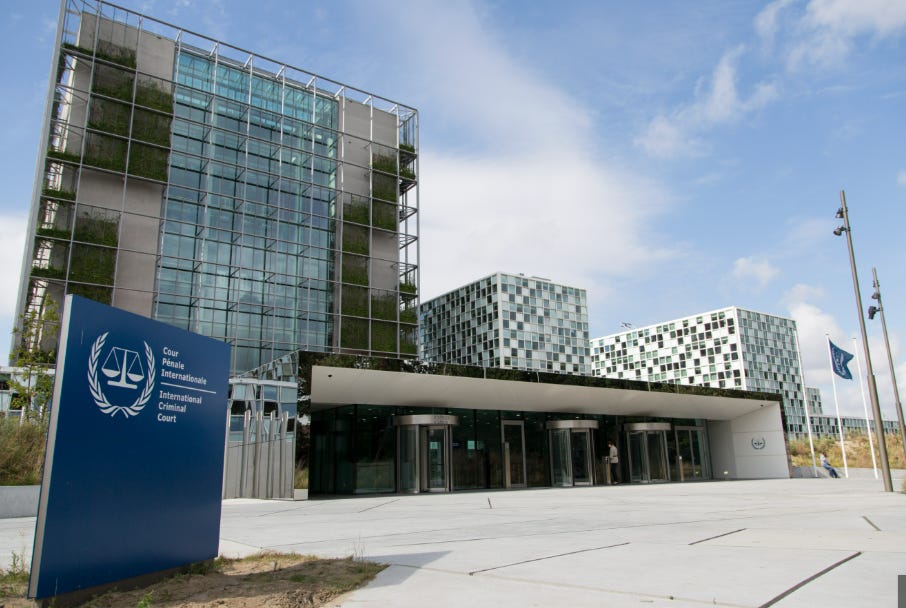
In 1998, 120 countries came together to adopt the Rome Statute, creating what would become the International Criminal Court. Four years later, that treaty entered into force, and the ICC officially opened its doors as a permanent court tasked with prosecuting individuals accused of war crimes and crimes against humanity.
Looking around the world today, it’s obvious that the ICC has not put an end to war crimes or crimes against humanity. It’s “deterrent effect” may be muted, but even so, the court—and the treaty that created it—have profoundly shaped international politics in ways that are often overlooked.
My interview guest today is Mark Kersten. He’s a Senior Consultant with the Wayamo Foundation and an Assistant Professor of Criminology and Criminal Justice at the University of the Fraser Valley in British Columbia. We start with a brief history of the ICC, and then dig into how the court has influenced not just legal definitions of war crimes and crimes against humanity, but how states themselves behave.
When we spoke, Mark Kersten had just returned from the ICC’s annual Assembly of States Parties, the court’s main governing body. He explains why that meeting offers a window into some of the biggest challenges the ICC now faces, including the very real possibility of U.S. sanctions—not just against individual court officials, but against the institution itself.
The episode is freely available on Apple Podcasts, Spotify, or wherever you get your podcasts. You can also listen directly below.
This episode is produced in partnership with Lex International Fund, a philanthropic initiative dedicated to strengthening international law to solve global challenges. It’s part of our ongoing series highlighting the real-world impact of treaties on state behavior, called “When Treaties Work.”
Transcript edited for clarity
Mark Leon Goldberg:
Well, Mark, thanks so much for speaking with me. To kick off this conversation, I would be curious to have you take listeners back to the mid to late 1990s and explain the reasoning behind the advent of the International Criminal Court and the Rome Statute, the treaty upon which the court is based.
Mark Kersten:
So, you have in the 1990s, this kind of liberal, cosmopolitan political and legal euphoria. All of a sudden, projects that weren’t possible because of the Cold War become possible. And one of those projects, which more or less was stalled after the Nuremberg trials, is international criminal justice. And so, two tribunals are set up in the early to mid-1990s, both in relation to atrocities, the genocide committed in Rwanda in 1994, and the other, the atrocities that are committed in the context of the collapse of the former Yugoslavia. So you have the ad hoc tribunal for the former Yugoslavia, and then an ad hoc tribunal dealing with the genocide in Rwanda.
Mark Leon Goldberg:
And, Mark, because I am a bit older than you. I should note that I was an intern at the ICTY, the International Criminal Tribunal for the former Yugoslavia in the early 2000s on the Milosevic trial. So, I can get into the history a little bit.
Mark Kersten:
Okay. So you know, the sense. So, I wasn’t there, but from talking to people during that time, prior to 911, there’s this excitement, there’s this belief, there’s this, again, this liberal cosmopolitan kind of conviction that not only international criminal justice, but things like the responsibility to protect the landmines convention, liberal peace building models, etc. can kind of finally come to fruition.
And at the same time, while you have these ad hoc tribunals and a couple of other courts that are being set up to deal with atrocities that are also supposed to be impermanent, there’s this view that this is the perfect time to try to get states to agree to a permanent international court capable of addressing, investigating, and prosecuting international crimes at the time, war crimes, crimes against humanity and genocide, and more recently, at least to some extent, potentially the crime of aggression.
And so, states gathered, for a long time actually, through the International Law Commission and discussing what a statute would look like. And finally, then high level state representatives gather in 1998 in Rome, and ultimately in a pretty remarkable way, and in the sense that I don’t think it would happen today, but states agreed to what we now call the Rome Statute of the International Criminal Court, which breathes life into international criminal law as a permanent feature of international relations and international law, and which, by the 60th ratification of the Rome Statute, creates the permanent ICC, which happens in 2002.
Mark Leon Goldberg:
Yeah. So, it was actually. And in 2003 when I was in The Hague at the ICTY, as the ICC across town was getting staffed up and, as you say, it really was this kind of moment in history, a real optimistic moment for those who believed in progress against crimes against humanity and war crimes, who believe that there is an opportunity to end the impunity around which these crimes had so routinely been committed, and really building off the examples of the Rwanda and the Yugoslav War Crimes Tribunal. So, the ICC was created, the Rome Statute entered into force. Can you just explain to listeners who are like less familiar, what does the ICC do, and how does it do it?
Mark Kersten:
In a nutshell, the ICC is mandated to investigate and prosecute for core international crimes — war crimes, crimes against humanity, genocide and the crime of aggression. The crime of aggression being the commission of illegal warfare, the unlawful invasion of one country or one state by another. There are some real distinct challenges with the ability of the ICC to investigate and prosecute the crime of aggression, but the others are more or less unproblematic under the Rome Statute. And the ICC has investigated and prosecuted war crimes on multiple occasions, crimes against humanity on multiple occasions, and has one warrant, that we know of at least, in relation to genocide pertaining to former Sudanese President Omar al-Bashir over alleged genocidal acts committed in Darfur.
The ICC can investigate any state that has joined the ICC, and currently, there are 125 member states of the ICC. I was just at the Assembly of States Parties, I know we’ll talk about that, where Ukraine for the first time attended as a member state. It is the latest member state. At the same time, other states are signaling that they want to leave the Rome Statute system, and therefore leave the ICC. Hungary has signaled that it wants to leave over basically trouble that it got into that it doesn’t think it should have gotten into over hosting Israeli Prime Minister Benjamin Netanyahu in Budapest. Benjamin Netanyahu has a warrant against him by the ICC on allegations of war crimes and crimes against humanity, and then four Sahel countries, which also have signaled they want to leave.
But, again, in principle, the ICC has jurisdiction over any state that has joined the court. It has jurisdiction over any citizen of a state that has joined the ICC. So, for example, I’m sitting here in Canada. If a Canadian went to, let’s say, Iraq and committed war crimes, even though Iraq is not a member state of the ICC, Canada is, and therefore, a Canadian that commits an international crime on a territory of another state can still fall under the jurisdiction of the ICC. And this ends up mattering, for example, because Russia is not a member state of the ICC, but Ukraine is, and so the ICC has jurisdiction on the territory of Ukraine, but it also has jurisdiction over any acts that, for example, Ukraine might commit abroad.
So, this ends up actually mattering, what we call personal jurisdiction. And finally, in very rare instances, really only two cases, the ICC can also exercise jurisdiction where the United Nations Security Council refers a situation to the court. And in that instance, it doesn’t matter whether that situation is in a member state of the ICC or not. So, for example, Darfur was referred to the ICC in 2005, despite Sudan not being a member state of the ICC. And Libya was referred to the ICC in 2011.
Mark Leon Goldberg:
So, I’m glad you got into these jurisdictional questions, because there is, I think, a lot of confusion around them in like the general international affairs public, not like ICC nerds like you and I, though, Mark, but I am glad that you got into that. So, we are now at, it’s been 20 something years since the ICC opened its doors. What would you say are some of the top accomplishments of the court in terms of like bringing cases to trial?
Mark Kersten:
Yeah, so it’s obviously been a mixed bag, but the ICC has successfully prosecuted a number of really important cases. I would say that no case is kind of free of any controversy because of the magnitude of the crimes. And we’re talking about international crimes. And, as you know, Mark, and I’m sure many listeners will know, these crimes end up being quite politicized. So, while you prosecute one thing, you might be leaving out someone else or something else, or while you’re prosecuting a particular type of war crime, you may not actually be dealing with the entities or states that kind of fuel that war crime or allow that war crime to happen. So, there are no really uncontroversial cases, but there’s really important cases.
So, in the Lubanga case, for example, one of the ICC’s first, it prosecuted the use of child soldiers in a really important verdict and contribution to case law.
Mark Leon Goldberg:
And this was in the context of the fighting in DRC.
Mark Kersten:
That’s right. The Democratic Republic of Congo. Exactly. In the context of Mali, it successfully prosecuted an individual who was part of a terrorist organization for the war crime of destroying cultural heritage, specifically in Timbuktu. And that also elevated the importance of how cultural artifacts and cultural places can be destroyed as a war crime. It’s contributed through a number of different cases to helping to establish new standards in how sexual and gender-based violence is prosecuted. Just recently, if convicted for the first time, someone from Sudan, Ali Kushayb, and, I think it’s 27 counts of war crimes and crimes against humanity. And so, it’s contributed quite significantly in those instances to not just producing case law, but to the victims of those particular perpetrators, it’s contributed quite significantly, I think. That’s my sense in engaging with people who work at the ICC, but also who work in these states or with diasporas from these communities.
And I think that really matters. Is it enough? No. If we think about what’s happened in Darfur since 2002, is one prosecution enough? Of course not. But at the same time, I think there are significant successes, and there’s potentially more to come. Perhaps the most notable case right now is the case of the former president of the Philippines, Rodrigo Duterte, who is going to trial at the International Criminal Court for crimes against humanity related to his so-called drug war in relation specifically to what are likely to be hundreds, if not thousands, of extrajudicial killings. So, killings of suspected drug users and drug dealers. But he was very clear, as people will remember, was very clear that he supported and endorsed and actually participated directly in himself at times.
Mark Leon Goldberg:
So, I’m fascinated by your rundown of some examples in which the ICC has advanced like case law when it comes to war crimes and crimes against humanity. I’m curious, though, to learn if, in more of a political sense, how or if the Rome Statute and the ICC have, in a similar way, nudged the world towards less war crimes and less crimes against humanity and less genocide? to play the devil’s advocate, and it’s not like a difficult argument to make, you survey the world today, from Gaza to Ukraine, Sudan and elsewhere, and there are still rampant crimes against humanity that have been ongoing and have gone unpunished.
Mark Kersten:
Yeah. So, I think we’ve talked about this before. I have always been something of a deterrence skeptic in the sense that I think there are lots of reasons to support the International Criminal Court and its work, primarily around its limited but real capacity to deliver justice and to create a forum where victims and survivors and affected communities can channel efforts to have a world body, an international court and an international organization acknowledge their suffering as a war crime, as a crime against humanity, as an act of genocide, etc.
But you’re absolutely right. You know, it would be foolish for somebody to say, from 1998 till now, the ICC has had a significant deterrence impact on the commission of the crimes which it has jurisdiction over because of precisely the contexts that you named. And I don’t know for sure, but it certainly doesn’t feel like the kind of eyeball test, like there are less international crimes being committed today than there were a couple of years ago, let alone 1998.
Now, at the same time, I do think there are at least some interesting examples where you could argue that the International Criminal Court’s interventions into particular situations has had some deterrence impact. How you prove that is a very difficult topic because it’s difficult to prove that something didn’t happen because the ICC intervened because how do you prove something that didn’t happen? But at the same time, I think one that sticks out to me is the context in Kenya. So, in 2007 and 2008, there was post-election violence in Kenya, a series of mass displacements, murders, sexual violence, etc. And the International Criminal Court Intervened and ultimately issued summonses, which are slightly different than arrest warrants. But it basically targeted a number of individuals on both sides of this post-election violence that had been so deadly in Kenya.
And the two most famous people that the ICC sought to prosecute were William Ruto and Uhuru Kenyatta. Now, 2013 rolls around and Uhuru Kenyatta and William Ruto, who are, prior to this, on opposing sides and kind of lifetime political enemies, come together and form an alliance, the so-called Jubilee Alliance, and run on the same ticket in Kenya’s 2013 political presidential elections. And they win. And it’s very clear that the only reason they run together in this alliance is in order to thwart the ICC investigation and potential prosecution against both of them.
So, 2013, that presidential election doesn’t have political violence like we saw in 2007 and 2008, and the subsequent election in 2018, I believe it was also doesn’t have this severe political violence, in part because the two individuals who otherwise oppose each other are in this political alliance, which has since fallen apart, and so we’ll see what happens. But ICC cases ultimately fall apart, in part because they were poorly constructed at the court, but also in part because there was a organized effort to intimidate, if not murder, some of the key witnesses in the cases against Ruto and Kenyatta. So, the cases fall apart. So it’s not a good story for justice.
Mark Leon Goldberg:
But it has like a political relevance that maybe is, even though like justice might have not been served, it did, as you suggest, induce the alleged parties to work together and not fight each other. And that overall reduced levels of political violence. That’s interesting. I’m wondering, beyond this question of deterrence, though, could you identify ways in which the Rome Statute has influenced state behavior one way or another?
Mark Kersten:
I think you’re on to something really important here, which is we tend to, and I say we, I mean, people who follow the ICC and in fact are in international law and international criminal justice world, tend to conflate the Rome Statute with the International Criminal Court. And to some extent, that makes sense. But the statute kind of has a life of its own that’s also separate from the court as an institution. And I can give a couple of examples of that. So, for one, for example, in 2002, there were riots and horrific violence in India, in Gujarat, in western India. And both lawmakers, some members of parliament and civil society really tried to address the atrocities that were committed by Indian state agents and the police, and what they used, even though India is not a member state and is not going to become a member state of the International Criminal Court, what they used as their kind of standard bearer to shape new legislation in India in the subsequent years was the Rome Statute.
It became the way in which attempts to address impunity were articulated. That’s a really important story. In the Democratic Republic of Congo, which is a member state of the ICC, you may remember the horrific atrocities around 2013 and 2016 in Kavumu, where very young children were raped, some as young as 18 months. And there was an effort to hold militia men, but also members of Parliament, who had been responsible to account. And one of the members of Parliament, Frederic Batumike, basically said, “I have immunity as a member of Parliament.” And what local actors and the local courts did in the Democratic Republic of Congo is say, “Actually you don’t. And the reason why you don’t have immunity from prosecution for these atrocities is because the Rome Statute strips you of immunity for crimes against humanity.” And, ultimately, he was prosecuted and convicted with 11 Congolese militiamen.
Then you have other things, like the hybrid courts that are established or people are trying to establish in the Central African Republic, where there is one in Kosovo, where there is one in South Sudan, where there’s not yet one, etc. And the Rome Statute really is seen as, in many respects, the kind of gold standard. And then even where there’s been zero accountability from an international court or the domestic level in the country, a country like Syria, what you have is dozens, at this point, of universal jurisdiction cases.
And universal jurisdiction allows states to investigate and prosecute international crimes, even when the crimes were committed beyond its borders against citizens of another state and by citizens of another state. And the only justice that’s been produced for Syria is under this principle of universal jurisdiction. And those cases all rely, as far as I know, every single one relies on the Rome Statute being domesticated into the country, whether it’s France, Germany, Sweden, whatever, being domesticated into the domestic law of those countries and, therefore, allowing them to investigate and prosecute these crimes.
Mark Leon Goldberg:
I mean, that’s fascinating to me because, oftentimes, when we focus on treaties in general and really the ICC in particular, we look at the fact that the United States, that Russia, that China, that India, all these key countries exist outside of it, have not ratified the Rome Statute yet. Despite that, you do still see it having a real discernible impact.
Mark Kersten:
Yeah, absolutely. I mean, and it has an impact also on these states that are not member states. Vladimir Putin’s team has been clear that he worries or his team at least worries about his travel plans because he doesn’t want to be arrested because he also faces an arrest warrant over war crimes and crimes against humanity committed in Ukraine. A couple of weeks ago, when Benjamin Netanyahu was traveling to the United States to the white House, his flight path was published. And it was this weird squiggle line that went over parts of Europe but really avoided other parts of Europe. And it was clear that his plane had taken this route so that it didn’t cross over the airspace of countries that Israel thought might force his plane down and force him to be surrendered to the International Criminal Court.
And just, I think, yesterday, Reuters had a story that the Trump administration is threatening additional sanctions against the International Criminal Court, perhaps as an institution as a whole, as opposed to just its key staff, it’s threatening these additional sanctions. If member states of the ICC don’t amend the Rome Statute to effectively creative carve-outs that would protect Trump and other people like Pete Hegseth, the Secretary of War, from prosecution after 2029. So, after this administration’s time is up. And there’s two ways to read this. The one way to read this is the kind of cynical take, which is so politicized, and, of course, it is politicized, but this is so bad that shows the weakness or the fragility of the international criminal justice system. That is definitely one way to read this.
But the other way to read this, which I think is just as valid, if not more valid, is to say, look, this is an indication that the most powerful states in the world have to care about what the International Criminal Court does. And aside from only investigating and prosecuting specific cases of war crimes, crimes against humanity and genocide, one of the goals, I think, of the International Criminal Court should be to make people who might otherwise be perpetrating these kinds of crimes uncomfortable, and make them think twice. And I think there’s evidence, at the very least in those instances that I just mentioned, that that’s what’s happening.
Mark Leon Goldberg:
So, we’re speaking on December 11th. You are just back, last week, from the Assembly of State Parties to the Rome Statute. This is the governing body of the ICC. And I’m curious to learn from you how delegates to the ICC today view its impact and its potential, particularly as you’ve seen the ICC as an institution being squeezed, on the one hand, by the trumpet ministration, which has sanctioned various ICC officials and is threatening even deeper sanctions against them, including potentially secondary sanctions on their financing. On the one hand, and Russia, of course, is also mounting campaigns against the ICC. So, as delegates gathered in The Hague last week, what was the mood, the vibe, considering all this?
Mark Kersten:
Yeah, it was in equal measure frustrating, troubling, inspiring, and resilient.
Mark Leon Goldberg:
Yeah. Break that down for me.
Mark Kersten:
Yeah. And if it’s not too uncouth, I wrote a breakdown about my time there and the atmosphere on my blog, Justice in Conflict, a lengthier article on what was happening there.
Mark Leon Goldberg:
Plug away, please.
Mark Kersten:
Thanks, Mark. So, on the one hand, there was a real effort by both the senior-most staff of the ICC and states that were at the Assembly of States parties to put on a brave face and say, “We are resilient. These are troubling times, but we are undeterred. We are going to continue. We’re going to fight.” And you saw that also amongst civil society groups? Civil society groups, including from Palestine, which are themselves under sanction, were very clear, right? “We’re not going to stop. We’re going to continue. We are undeterred.” At the same time, there was almost a hedging of bets kind of atmosphere where states would talk about threats or the existence of a crisis or intimidation tactics against the ICC. And some of them sometimes would mention the word sanctions, but none. As far as I know, none.
And I might be wrong, but I didn’t hear any statement from a state that actually acknowledged that the sanctions come from Washington. So, there was a willingness to kind of articulate that there was a problem. But this problem basically could have come from anywhere, from outer space, as if the sanctions were this thing that had arrived as opposed to had arrived from this particularly anti-ICC and, to a large extent, anti-international law government. And so that was a bit odd. And there were statements, including one that was issued by consensus, that articulated their worries about protecting the courts from intimidation and from threats, and then also said, “But we have to keep this space to continue dialog with nonmember states about their concerns about the ICC.
Mark Leon Goldberg:
They’re just afraid to poke the bear kind of thing?
Mark Kersten:
Exactly. And I think we should recognize that you and I are talking right now about the ICC, but for state delegates, they’re not. That’s not the only thing they’ll do. If you’re a Canadian or European, you’re also in the middle of negotiations over peace in Ukraine and peace in Israel and Palestine. But you’re also a negotiations over the potential reductions of tariffs, right? So, for them, for the diplomats, all of this is kind of, I’m sure, swirling around either their minds or they’re getting instructions, it seemed very clear instructions not to poke the bear, not to indicate that the United States was behind this. And I certainly never heard from any state the name Donald Trump. So, I think people found that frustrating that there was this hesitancy to call a spade a spade.
But we’ll see. Diplomats made interesting arguments about why they were doing that because they still want to keep open this space for dialog and avoid another round of sanctions. The scariest thing for them being sanctions against the court as an institution. Right now, there are sanctions against nine individual staff members whose lives have been turned upside down. Absolutely. They can’t use credit cards. They can’t book hotels. They can’t use Expedia. There are so many things they can’t do. If they travel home, they have to make sure that their flights don’t go anywhere near American airspace, which, for some of them, if you’re Canadian, isn’t the easiest thing to do. So, it’s really challenging for them.
But the biggest challenge for the court and for its supporters and for states would be if the court as a whole, as opposed to individuals within it, were sanctioned. That would really throw a wrench in the ability, for example, of the court to pay its staff, to use banking systems, financial systems, etc. And so, I think states want to keep open this space for dialog to ensure that that doesn’t happen by not, as you put it, I think, really well, poking the bear. So, you had very, again, these mixed feelings and then real special moments. So, I mentioned earlier in our conversation that Ukraine was there for the first time as a member state of the ICC. And I was in the Assembly when they were welcomed. And was a remarkable, beautiful standing ovation, basically, and rousing round of applause to welcome Ukraine.
So, there were definitely special moments like that. And I think the resilience of certain civil society actors, like Palestinian NGOs that have been documenting human rights violations and international crimes in Gaza and the West Bank, was also really inspiring for people to see because those were sanctioned people standing up and saying, “You know what? We’re not going anywhere. Gaza won’t be the cemetery of international law. We’re going to keep trying.” So, a real mixed bag, and it remains to be seen what happens in the future. Are we in the eye of the storm? Is this like a certain moment of calm, and it’s going to get rougher again? Or are there actually off-ramps that are available?
To me, that’s the biggest question. Can you protect the independence of the International Criminal Court without escalating tensions with the United States? Is that possible? So, can you continue your investigations into Palestine and potentially continue issuing arrest warrants in Palestine whilst also not poking the bear? Can you protect the independence of the court whilst de-escalating somehow? And that’s a big challenge for states.
Mark Leon Goldberg:
Yeah. I mean, as you describe it, I mean, it sounds like there’s almost like this kind of sword of Damocles hanging above the court in the form of potential institution-wide sanctions that would be levied against it by the United States. And I take it that that outstanding question will sort of remain until those sanctions are either imposed or until the end of the Trump administration. So, how else can the ICC continue to try to live up to the Rome Statute in that very sort of complex and difficult future, near-term future that it faces?
Mark Kersten:
It can only do so if its member states want it to do so. And so there is a law in Europe on the European Union books, and in fact, for the exact same reason, a Canadian law exists. Very briefly, the background to this law was the U.S. sanctions against Cuba, which were seen by the rest of the Western world, I think this was in the 1990s, as being politically motivated as opposed to legally motivated. A bunch of Cubans were put under sanctions because Cuba was communist, basically, by the United States. And Europe and Canada did not want to comply with those U.S. sanctions, and so created laws, and Canada as part of the foreign extraterritorial measures Act, and in the European Union, it’s called the blocking statute, which effectively allows the European Union and Canada to invoke this law, which then protects all of their institutions, say companies, businesses, financial institutions, banks, etc., airliners, etc.
It protects them from being in trouble, for lack of a better word, if they engage with otherwise sanctioned people. So, if states want the ICC to continue to function and undeterred in an independent fashion, the European Union and Canada need to invoke these statutes in order to protect the staff and perhaps the entire entity of the International Criminal Court, because if not, I don’t think we’ll see the ICC disappear, but it will limp. It will be a shadow of what it has shown some degree of promise it could be. It will still prosecute the cases before it, but it will be this court that is kind of forced to pull punches, isn’t capable of fully financing investigations into new situations, and whose staff are probably going to be extremely demoralized because they aren’t able to do the important work that they otherwise would do.
So, there is a pathway to protecting the court’s independence through concrete measures like the blocking statutes and parts of the Foreign Extraterritorial Measures Act. Whether states invoke it remains to be seen. The other thing, of course, which is more of a diplomatic issue, is the extent to which these states, Canada, European states, but also African states, Latin American states, etc., allies of the United States, at least erstwhile allies of the United States, articulate the importance of the court in other negotiations with the United States, be it over peace in Ukraine or Israel, Gaza, or negotiations over new trade deals with the Trump administration, or whatever it may be.
,
And if they care about it, my personal view is that it’s in those alternative spaces and discussions that some of the most important work in protecting the independence, and indeed the existence of the ICC, has to take place.
Mark Leon Goldberg:
That’s fascinating. You know, around the UN over the last year, there’s been just a lot of talk about the growing relevance and importance of middle power diplomacy in the here and now, but also in the future, given actions undertaken by the Trump administration, but also just given broader geopolitical rivalries around the world. And, as you are giving me your answer, I couldn’t help but think that the ICC will be an important indicator and potentially venue in which this middle power diplomacy might exert itself in the ways that you articulated. So, that’s fascinating.
Mark Kersten:
That’s such a good point, right? It’s a little bit of a litmus test for those middle power states. And yeah, I mean, it’ll be fascinating, I think, and really important to watch, including from, again, I wouldn’t just focus on, even though I did, on Canada and European Western states, but those other member states of the ICC in Africa and Latin America and South America in particular, whether they stand up and rally behind the court that they helped to create.
Mark Leon Goldberg:
Well, Mark, I always appreciate speaking with you and learning from you. Thank you so much for your time.
Mark Kersten:
Thanks for having me on the show.
Mark Leon Goldberg:
Thanks for listening to Global Dispatches. The show is produced by me, Mark Leon Goldberg. It is edited and mixed by Levi Sharpe. If you are listening on Apple Podcasts, make sure to follow the show and enable automatic downloads to get new episodes as soon as they’re released. On Spotify, tap the bell icon to get a notification when we publish new episodes. And, of course, please visit globaldispatches.org to get on our free mailing list, get in touch with me, and access our full archive. Thank you!
The interview regarding the ICC was outstanding. Law and order at the global level has been missing and is a core weakness in the UN Charter. The introduction of the World Constitution & Parliament Association's EARTH CONSTITUTION to replace the obsolete and fatally flawed UN Charter can bring new support to the ICC and the Assembly of State Parties. The ASP should join the Earth Constitution Movement in order to gain more strength and protection for the ICC.
The EARTH CONSTITUTION, unlike the UN Charter, has a well thought out World Judiciary System with Enforcement. The ICC will fit in nicely, and can benefit from the EC's authority. -- Dr. Roger Kotila, President, Democratic World Federalists