


There are certain events or scenarios that, should they unfold, would threaten large swaths of humanity across multiple continents. These are often referred to as Global Catastrophic Risks for their potential to disrupt lives and livelihoods on a massive — even planetary — scale.
The consequences of these risks are terrible, involving unimaginable levels of death and destruction. But while these dangers are very real, they are not inevitable. They can be prevented.
To that end, I’m proud to announce a new partnership between Global Dispatches and Global Challenges Foundation around a series of podcast episodes that examine specific global catastrophic risks and explore how they can be prevented through enhanced international cooperation. These risks include catastrophic climate change, weapons of mass destruction, artificial intelligence in military decision-making, near-Earth asteroids, and the topic of today’s episode: ecological collapse.
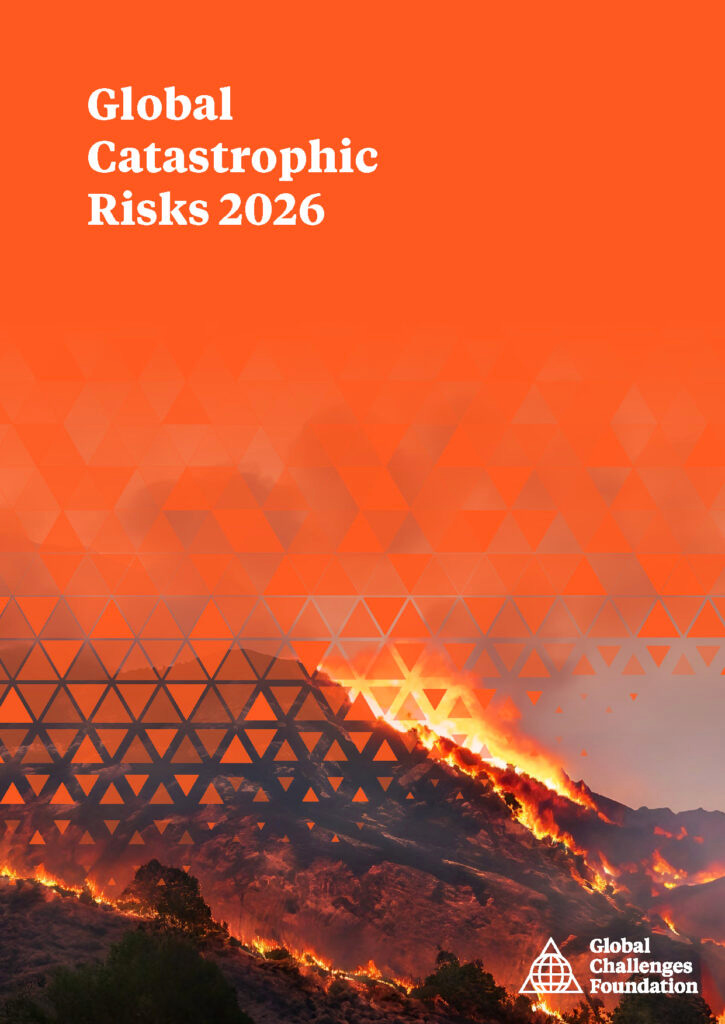
Each year since 2012, Global Challenges Foundation has convened a wide range of experts to produce an annual report on Global Catastrophic Risks. This podcast series is drawn from the newly released 2026 Global Catastrophic Risks Report. Like the report itself, the series examines both the risks and the steps needed to strengthen systems of global governance to prevent these calamitous events from ever unfolding.
The debut episode focuses on ecological collapse and features insights from David Obura, director of CORDIO East Africa, a nonprofit research organization based in Kenya, and chair of the Intergovernmental Platform on Biodiversity and Ecosystem Services, and Eva Mineur, head of climate and sustainability at Global Challenges Foundation. We begin by discussing what ecological collapse entails and how it affects humanity, before turning to a broader conversation about what the international community can do to prevent this global catastrophic risk.
The episode is freely available across all major podcast platforms, including Apple Podcasts and Spotify. You can listen directly below.
To receive new episodes as soon as they are released, sign up for a free or paid subscription to this newsletter.
Transcript edited for clarity
Mark Leon Goldberg:
To kick off, what do we mean by ecological collapse?
Eva Mineur:
When we talk about ecological collapse, I mean, we’re not talking about environmental damage in general or about nature slowly getting worse year by year. I would say that ecological collapse happens when an ecosystem loses its ability to function, when it can no longer regenerate or regulate water and climate, or support the people and economies that depend on it. And at that point, the system doesn’t just degrade gradually. It can actually flip into new degraded states.
And the crucial idea here is tipping points. I mean, much of environmental governments assumes continuity that a bit more pressure leads to a bit more damage, and that systems remain broadly stable as conditions change. But many ecological systems, they don’t behave like that. They have thresholds. So once those thresholds are crossed, the system reorganizes itself into something new.
Mark Leon Goldberg:
Are there places around the world today that either have undergone ecological collapse or are in the midst of it?
David Obura:
Oh yes. So, many parts of the globe have already gone through ecological collapse. I mean, most of the European continent has gone from a complete transition of the ecosystems that were there before 10,000, 15,000, 20,000 years ago, to what they are now, which is highly altered systems with some forest, of course, and natural spaces, but not what they used to be, not in their natural state.
And then, currently, if you look at most of the Indian subcontinent, for example, is highly populated, and the original ecosystems have been completely replaced by human-altered systems, where there’s a lot of farming and agricultural pastoralism. Same with many parts of Africa going through that transition in many parts of Latin America as well. So, ecosystem is always in some level of flux, of course, as things change, that is, the human footprint really expands a lot. We’re driving many ecosystems close to points of collapse.
Eva Mineur:
I mean, one of the clearest and classical examples is the Aral Sea in Central Asia. I mean, for decades, the rivers feeding the sea were diverted to support large-scale cotton farming. And the goal was, of course, economic development, and the ecosystem was treated as something that would simply adjust to that. But instead, the system crossed a tipping point.
And, as water inflow declined, the sea shrank rapidly by 90%, actually, and salinity increased and fish stocks collapsed. Then local climates became harsher and toxic dust storms spread chemicals across the region, so livelihoods disappeared and public health suffered severely. So, this wasn’t just an environmental damage. It was this systemic reorganization of the region’s ecology and economy and, thus, an ecological collapse. And from a governance perspective, I mean, it really shows what happens when ecosystems are treated as infinitely flexible and decisions are made sector by sector and the long-term system stability is sacrificed for short term gains.
Mark Leon Goldberg:
Well, so if ecological collapse is already happening in many places, yet, we, as a human species, seem to be muddling through, what makes ecological collapse, therefore, a catastrophic risk?
David Obura:
Well, muddling through is probably the right way to put it for that because we are just sort of muddling through as if the final consequences won’t be dire. So, what has happened historically is that as European ecosystems have diminished and collapsed, European societies basically sought natural resources from further afield — Asia, Africa and the Americas — and the entire sort of imperial and colonial sort of era for Europe was about importing subsidies of nature from other parts of the world because they could no longer supply them from their own territories.
So, now, if we progress that across all terrestrial areas where people live, but now population density is much higher than it was hundreds of years ago, when the economic systems are much more impactful and consume much more energy and physical materials and water, and biomass, we’re overconsuming the productive capacity of the planet. And so, more and more ecosystems crossing that point of collapse is a crisis for humanity because we are, in the end, fully dependent on nature, much as we think we’re not. Our economic systems are highly dependent on nature. So, we really need to maintain that productive capacity for us to survive and for our economies to survive as well.
Eva Mineur:
I mean, you can say it’s the hidden foundation of things we take for granted — food, water and a stable climate. So, when one ecosystem breaks down, societies can often cope. But when many ecosystems weaken at the same time, the effects travel. And tipping points are not isolated. They’re all connected. So, the collapse of forests affects rainfall far away. And melting ice alters ocean circulation. And coral reef dieback undermines fisheries income and food security, triggering social and economic ripple effects.
So, what begins in one region does not say there. Another reason is that ecosystem doesn’t just support life, they actually help to regulate the planet itself. I mean, healthy forests absorb carbon and oceans soak up heat and frozen ground logs greenhouse gases away. But when these systems break down, they stop helping and start hurting instead. So, that means that forests release carbon instead of storing it. And the oceans absorb less heat and carbon dioxide. And thawing permafrost releases gases that further warms the planet, etc. So, this creates a dangerous loop. Damage causes warming, warming causes more damage, and the cycle speeds up, and so on. And the final reason or argument I’ll give you here is that ecological collapse makes everything else riskier.
So, societies with healthy ecosystems, they can absorb shocks, but societies under ecological threats, they can’t. So, collapse acts like a type of risk amplifier, it makes pandemics deadlier and conflicts more likely and mistakes harder to recover from. So, it really shrinks our room for error at exactly the wrong moments.
Mark Leon Goldberg:
It would seem that sort of managing natural resources on a global scale is something that ought to very much fall under the kind of provenance of global governance. Over the years, what have been some of the platforms or tools of global governance that have been created or engineered to try to prevent this disastrous outcome?
Eva Mineur:
I mean, the international community has actually created a substantial governance architecture, I would say. And some of the key elements include, of course, the multilateral environmental treaties. I mean, since the ‘70s, governments have tried to manage the ecological risk mainly through international treaties. I mean, this includes, of course, agreements like the UNFCCC, the UN Climate Convention, the Paris Agreement, and different biodiversity treaties, and the well-known successes.
Many probably knows about the Montreal Protocol on ozone-depleting substances. So, the basic idea behind these treaties is, of course, that countries agrees on shared goals and report on the progress and then try to coordinate action on problems that cross borders. But from a risk perspective, these treaties are humanity’s main attempt, so to speak, to collectively manage ecological risks. But they have, of course, clear limits. And most of them are voluntary. The enforcement is weak. Environmental goals are often disconnected from economic and security policy, which is a big problem. And, I mean, the Montreal Protocol actually worked quite well, and that was largely because the problem was narrow and alternatives were available at that time.
Mark Leon Goldberg:
And this is the protocol that successfully resulted in the closing of the hole in the ozone layer in the late 1980s and 1990s, yeah?
Eva Mineur:
Exactly.
David Obura:
We have been consuming across the planet at global scales, and global governance systems have evolved to address needs, not necessarily balance and preservation of the system. So, the trading system we currently have, I mean, it’s emerged from hundreds of years of trade through past centuries. And then in the middle of the 20th century, with the first and second World Wars behind us, global governance really sought to stabilize the global system to avoid war.
But it also locked into place the trading system that has really supported the economic boom of the ‘50s, ‘60s, ‘70s and so on, which, in many ways, is a good thing for many people around the planet, not for everybody, but for many people. It was, certainly created much more wealth than existed before through transforming natural wealth into economic and human and financial wealth. But the systems are all based, in the end, on maximizing production and growth and conversion of natural resources and wealth into human and financial wealth, and it’s very unequally shared.
So, now that we have reached planetary limits and, I mean, I love it in the report how we compare crossing planetary boundaries is a planetary challenge. Ecological collapse is really the manifestation or what that means on the ground. As we cross planetary limits, ecosystems collapse at local levels, and people experience that directly. So, we now need to shift to a global governance system that recognizes these limits and really promotes balance. So, we bring things that we’re doing that exceed those limits need to come back within limits. Things we’re doing that are not exceeding those limits can increase, but they need to be very cognizant of what those limits are and their interactions with all the other systems that they interact with.
Mark Leon Goldberg:
I mean, if present trends continue, are we inevitably on track for ecological collapse at a global catastrophic scale?
David Obura:
Certainly, we can’t be certain about when it would happen. And it happens first in some systems rather than others. But we’re already seeing that these high levels of ecological collapse happening across more and more of land spaces and ocean spaces as well, as these progress out to larger proportions of the biosphere, the living space that we depend on, those collapses will accelerate. And, as pointed out from the planetary boundaries piece, these risks cascade on each other. Some crossing certain boundaries increase the risk of other ones being crossed. In the case of ecological collapse, people are highly dependent on ecosystems. And if an ecosystem can no longer supply them, they will migrate or move or import from another ecosystem.
And that just projects that pressure elsewhere without rebuilding the capability of the system that is just being collapsed or overused. So, yes, continuing at the pace that we are and continuing to accelerate, these ecological collapses will build up towards planetary-level collapse.
Mark Leon Goldberg:
So, Eva, you’ve mentioned a gap in global governance when it comes to ecological collapse, I’m curious to learn from you and from David what can be done to more successfully retool our system of global governance to confront this potential catastrophe with the urgency it seemingly requires.
Eva Mineur:
I mean, if you talk short term like within the next, I don’t know, 10, 20, 30 years, I think is actually to draw clear ecological red lines. I mean, we can actually simply decide not to push any further. So that can mean, for example, to no further loss of primary tropical forests, no new destruction of intact peatlands or emergency protection for collapsing coral reefs or actually put hard limits on fishing where the oceans are already overexploited.
And I think this matters because tipping points don’t respond to small improvements. They respond to limits. So once again, from a governance perspective, I mean, red lines would actually potentially give some effect in a short-term perspective. I mean, they don’t fix everything, but they can at least prevent a failure in a short-term perspective. But then another thing to do on a short-term basis is to innovate or develop better governance mechanisms to better act on early warnings to actually monitor the right signals and respond to stress before they collapse.
And treat the ecosystem breakdowns with the same urgency as other emergencies. Tipping points, waiting until the damage is obvious often means waiting until it’s too late. So really to act on the early warnings earlier and develop governance tools that could do that for us. And I think it’s important to stress this, to actually treat the ecological collapse as a risk to security stability, and not just as this environmental issue. That means integrating the ecosystem risks into disaster planning, conflict prevention, national security strategies, and so on.
And it also means, of course, to better coordinate, on a national level, across the ministries. At least in Sweden, and I guess it’s the same basically everywhere, is that the ministries and the government usually works very separately. So, you have environment, agriculture, finance, defense, etc. next to each other in silos instead of working in a much more coherent way. And it’s about being much more prepared and also to be able to respond flexible and quick when we see the degradation or the effects of climate change, for example, etc.
David Obura:
It’s all about the drivers and pressures. We need to regenerate and restore those areas that have been degraded, for sure. But first we need to stop the pressures that are accelerating decline. And those, essentially, are of the economic system and high consumption levels, incentives towards short term material gain if best transformative change assessments and the Nexus assessment have really highlighted many of these issues. But the primary footprint comes from high income earners and the high-income sectors in the global economy. Those have to change first to avoid going over the edge. So, that’s in relation to carbon dioxide emissions. It’s the same for overconsumption of fish or of other natural products. And we really need to understand how to bring these into sustainability limits.
Mark Leon Goldberg:
Do you see opportunities for, say, the international community or different like aspects of the international community to coalesce to reduce overconsumption, for example?
David Obura:
There are many opportunities in the global governance system going down to local levels to address the challenges such as overconsumption. It’s a choice people make every day. And there are convenings of global authorities, conferences of parties, groups from one month to the next. There are other ones in every year, some of them repeat every year, and some every two years.
There are always opportunities to make better decisions towards sustainability. And I think the longer that we put it off, the harder the choices are because the higher the cost of reversing directions and so on. So, yes, it’s a challenge for many countries, many economies to change what they’re doing. But I think we need to present that these are opportunities for change. The innovation involved will drive new economic opportunities, will drive jobs, will drive investment and subsidies, and so on. We just have to shift our values to enable those, rather than currently holding on to old values which impede those changes.
Mark Leon Goldberg:
So, if it’s a values shift that we’re seeking, does there exist any current platform for international cooperation, for global governance that might inspire this value shift?
David Obura:
I think we already have sufficient platforms for the global cooperation that are needed.
Mark Leon Goldberg:
Like what?
David Obura:
Well, the United Nations is one of those already. There’s a lot of discussion now about reforming or revitalizing, transforming the global governance system, the financial architecture. So, I think it’s very much a case of not throwing out the baby with the bathwater. I don’t think it’s fit for purpose for 21st century challenges. It wasn’t designed with these challenges in mind, but it can be rejigged profoundly to enable that to happen, but it takes a very hard political decisions of those who have the power in the system to enable that to happen. Because a big part of what needs to happen is to equalize power across countries and communities to really consider everybody’s needs — who needs more? Because many people do need more in terms of their income and their wealth and who are over-consuming.
And that that needs to be brought into light. So I think there’s plenty of opportunities, and I think the sciences, such as from the Earth Commission and from intergovernmental bodies like the IPCC and IPES, they’re all showing the way, and it’s really a need for the political processes now and the policy processes to really attend to that science and realize that we have a period of hard decisions to come. But the longer we delay those decisions, the harder it will be. And yes, it does need a profound shift in values. I think the Earth Commission shows up very strongly in its findings. It best addresses it around transformative change. So, the global community is not uniform. There isn’t just one value system on the planet. The economic value system is the one, the market one is one that is doing all the damage. There are plenty of much more egalitarian value systems, one where people don’t see themselves as separate from nature. They can live in and with and as nature in a much more harmonious way. There are many examples there — value systems that we could use that would be more efficient to balance in the planet, and providing for all people on the planet, rather than the mainstream one that we’re using now.
Mark Leon Goldberg:
Are there any concrete, actionable insights in terms of just like next steps to prevent this trajectory towards ecological collapse from proceeding as it has over the last 80s years?
Eva Mineur:
We really have to bring in future generation, the younger generation into today’s decision-making processes, and I can actually see signs of that. I mean, when I was at the COP meeting in Brazil a few weeks ago, I was excited to see that there were a lot of young people, visible and present in the dialogues, in the rooms, in the panel sessions, not only young people, but also young people from the indigenous people, not only from Brazil, but actually from all over the world.
So, I think that is really what we can hope for. I also feel that, I mean, now I get a bit personal, but I have teenagers back home here, and they struggle to find hope for the future. And it’s not only my kids, of course, it’s everywhere. But when you talk about the fact that they can actually… to give them agency and to give them opportunity to be part of the institutional decision-making processes, it feels like that is something that they can at least explore and hold on to.
Eva Mineur:
And I’ve seen a shift in that also from the policymaking level that they are at the tables, which was not the case 10 years ago, 15 years ago.
David Obura:
Well, so there’s no easy next steps, that’s for sure. It’s going to take a profound shift in many different ways. And I think the transformative change assessment from IPES really does provide many actions that could be looked at and strategies for next steps, but I think it’s important for those working in the global governance architecture in shepherding the way forward to see a couple of things. One is that I think we really need to integrate across the global governance system. So, across nature, economy and societal platforms, instruments, conventions. They can’t proceed in silos. They have to consider each other, and they have to come into balance with each other. And I think the second thing that is profoundly needed is that we have to stop, really, we do have to stop just prioritizing short-term material gains.
So, that’s profits on a quarterly or an annual basis in financial terms. And we have to shift towards long-term prosperity. So, what’s the balance of the system? What is the real tangible values or assets in nature in economies and society that we need to build up that are complementary to each other? And I think the Sustainable Development Goals give a pretty good disaggregation of the 17 elements across these three domains that we need to balance. And if we just do that, we will address other things that are not explicit within those goals, but of course can be brought in as we think through them towards 2030 and past 2030, of course.
But I think it is that value shift, and it is realizing that we have to integrate across all these domains rather than just prioritizing one or two indicators, such as GDP or money. One other thing I would like to mention, and this is something I address in the Ecological Collapse piece, is that it takes working across all scales to do this. I mean, we need global integration and coordination and alignment because we have reached planetary limits. 100 years ago, we hadn’t reached those planetary limits. So, if one community or one country or one group wanted to shift what they were doing, it didn’t have global consequences yet. But now it does. So, there’s no spare space on the planet anymore.
We have to deal with it at global levels. But we have to make it connect from global down to local scales. We need to enable local agency. That’s the best way to ensure people’s interests are met locally. And you can address the inequalities in the current system by ensuring people at local levels have enough and nobody is consuming or doing so much that they take away from somebody else. So, that connection between global to local and local to global is essential. And I think the model of nature, economy, and society, that’s what sustainable development uses, is enough to do that. We just need to apply it in very strong and systematic ways so that we’re balancing across all three, not undermining any of them in the interest of another.
Mark Leon Goldberg:
David and Eva, thank you so much for your time.
Eva Mineur:
Of course.
David Obura:
It’s been a pleasure.
Mark Leon Goldberg:
Thanks for listening to Global Dispatches. The show is produced by me, Mark Leon Goldberg. It is edited and mixed by Levi Sharpe. If you are listening on Apple Podcasts, make sure to follow the show and enable automatic downloads to get new episodes as soon as they’re released. On Spotify, tap the bell icon to get a notification when we publish new episodes. And, of course, please visit globaldispatches.org to get on our free mailing list, get in touch with me, and access our full archive. Thank you!