


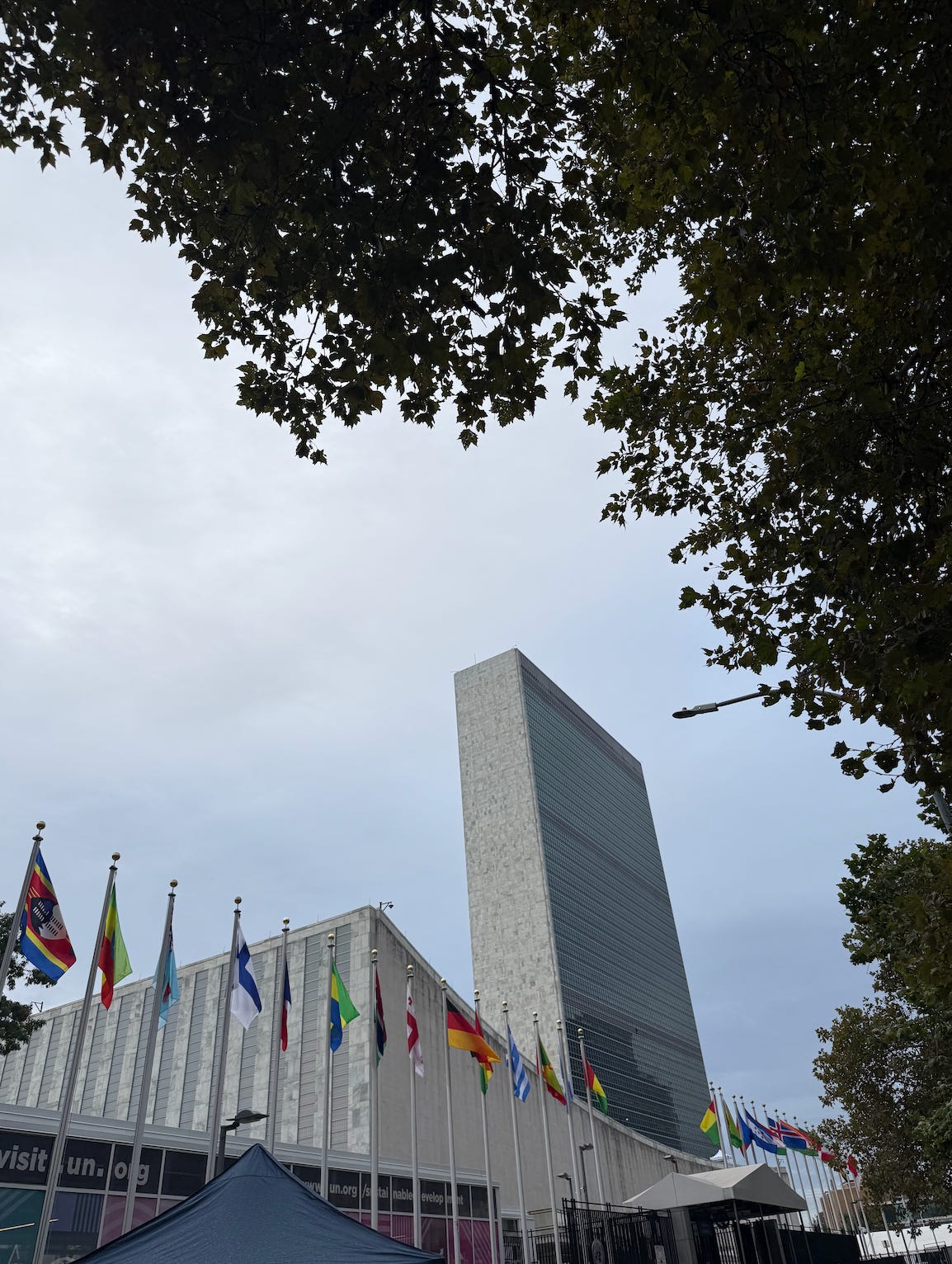
Hello from the United Nations! It’s been a busy two days. I wanted to share some of my quick, unvarnished thoughts about what we have seen around the UN, including Trump’s speech, how this is becoming the “AI UNGA” — and why this seems to be shaping up as a key inflection point for middle powers.
Quick programming note: Join Anjali Dayal, Harshani Dharmadasa, and me at 3 p.m. ET here on Substack Live for a breakdown of our key takeaways from the United Nations.
Trump’s Speech
This was a low-energy Trump speech, which was probably a relief for those around the United Nations. Yes, he predictably railed against “globalists,” but his tone was restrained.
I’d say three things stuck out from his speech.
First, he threatened to annihilate Iran! The presidents of Iran, the United States, and Israel are all in New York this week, so there was some speculation that UNGA might spur diplomatic progress in the Iran war. Not so. This line seems to have ended any notion that the UN might be a place where progress is made on de-escalating the U.S.-Iran conflict.
Second, he bragged about exploiting the natural resources of a country whose leader he deposed! “To the victor go the spoils,” Trump said of Venezuela’s vast oil reserves. I know it’s hardly unusual for Trump to say something like this, but it’s worth mentioning just how aberrational it is for an American president to make a statement like this on the grounds of an institution premised on preventing the kinds of wars of conquest that wrought the devastation that led to the advent of the UN 81 years ago.
Third, Trump’s remarks on artificial intelligence reflect his zero-sum view of the world. “Whoever wins Super Intelligence, wins,” he said, suggesting once again that he opposes guardrails that might slow progress on frontier AI models, fearing that any restrictions would give China a leg up.
This sentiment very much goes against the grain of the prevailing mood around the UN, which is that guardrails are needed to avoid the potentially calamitous consequences of runaway AI. Indeed, a succinct counterpoint to this worldview was offered yesterday by Finnish President Alexander Stubb. At an AI-themed event I attended, he said of the race for superintelligence: “It doesn’t matter who ‘wins.’ We are all screwed.”
AI Takes Center Stage
The big AI event is tomorrow at the Security Council. France is convening a meeting that frames AI as a potential threat. The first line of the meeting concept note circulated by the French says plainly that “recent developments in the field of artificial intelligence are a major international peace and security challenge.”
OpenAI’s Sam Altman and Anthropic’s Dario Amodei are expected to address the Council. There will not be any specific outcomes from this meeting, but I will be watching to see what these two leaders have to say about the need for international rules of the road or standards around the research and deployment of frontier models. It will be equally interesting to see how stridently the members of the Security Council, other than the United States, respond with their own calls for guardrails and regulations.
Just yesterday, a group of about 26 middle powers (ranging from Norway to Kenya and dozens of others) released a first-of-its-kind joint political statement, unequivocally calling for:
Companies to develop transparent safety protocols, including mandatory pre-deployment testing and independent evaluation, with qualified evaluators granted sufficient access to assess risks.
Governments and regional organisations to further develop and coordinate common standards, strengthen transparency — including shared reporting of serious safety incidents — and ensure that countries across all regions have access to scientific capacity, expertise and trusted evaluation.
UN member states to build on existing international mechanisms and explore creating an international institution able to set standards, enable verification, and convene states when capability thresholds are crossed.
Again, this puts these middle powers in conflict with the United States, which has explicitly rejected these kinds of guardrails. That leads me to my final observation about UNGA which is…
…Middle Powers Have Suddenly Realized They Have Agency
This is the UNGA where middle powers realized that they need not be passive participants in a world order dominated by the United States and China. Rather, they can take matters into their own hands. Credit here goes to Mark Carney for lighting a fire under the seats of the world’s middle powers.
On Monday, he announced, alongside Brazil, Kenya, and the European Union, a new Partnership for Multilateralism, which they billed as a flexible platform in which middle powers can come together in support of international law and the United Nations Charter, and use multilateral platforms to advance their common interests.
This joint political statement on mitigating risks from frontier AI is a remarkable example of that kind of middle-power diplomacy in action. I suspect we will see many other examples of this throughout the week, and that this UNGA will be remembered as the launching pad for a new era of middle power diplomacy.
That’s it for now— but I’ll have more soon from the UN. Please tune in to the livestream at 3pm ET for continuing coverage of UNGA.