


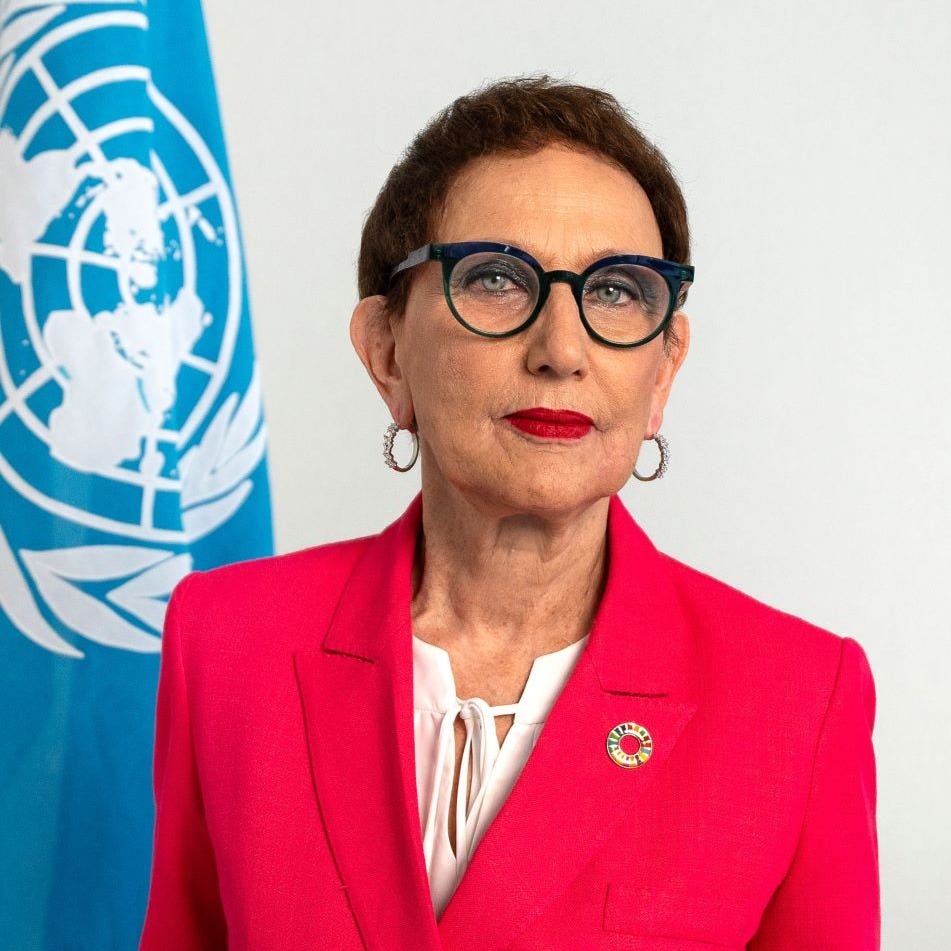
Rebeca Grynspan is one step closer to becoming the next Secretary-General of the United Nations. The Security Council held its fourth informal straw poll to test the viability of the seven candidates for Secretary-General — and this is now the fourth time in a row that Grynspan has been in the lead.
Each of the 15 members of the Security Council was given a ballot and asked to indicate whether they “encourage,” “discourage,” or have “no opinion” on each candidate. To win, a candidate needs the support of at least nine members and must not face opposition from any of the five veto-wielding powers: the United States, Russia, China, France, and the United Kingdom.
Grynspan emerged decisively on top in this vote, with 10 votes in favor, three “discourages,” and two “no opinions.” The other candidates were far behind. In a distant second place was Guyana’s ambassador to the United Nations, Carolyn Rodrigues-Birkett, who secured eight votes in favor but six “discourage” votes. At this point, she and the other candidates, including IAEA chief Rafael Grossi, probably face insurmountable opposition.
Adding to Grynspan’s tailwinds is the fact that her numbers are improving. In the last straw poll, taken earlier this month, she received five “discourage” votes, compared with three today.
But her improving prospects — and her rivals’ declining ones — do not mean that Grynspan is a shoo-in.
The ballots in this round did not differentiate between the votes of the five veto-wielding members and those of the other 10, so we do not know whether her opposition comes from the P5. And if one or more of those “discourage” votes does come from the P5, we don’t know whether that position is firmly held or whether it’s just posturing. (More on that below the fold!)
Who, exactly, is Rebeca Grynspan?
Grynspan is well known around the UN. She’s an economist and former Costa Rican politician who has risen through the ranks of the UN system to become head of the UN Conference on Trade and Development, a Geneva-based UN body focused on helping developing countries use trade, investment, finance, and technology to support economic development.
It was from this position, in 2022, that she emerged as a prominent international negotiator.
Following Russia’s full-scale invasion of Ukraine in February of that year, food prices around the world soared. Ukraine is a global breadbasket, but its agricultural exports were effectively trapped. Grynspan became a key player in the UN-led negotiations that produced the Black Sea Grain Initiative and a parallel agreement aimed at facilitating Russian food and fertilizer exports. The resulting arrangements enabled Ukrainian grain to once again reach global markets. She has touted this experience as an example of how the UN can mediate even in the midst of a devastating conflict.
Grynspan, notably, is also of Jewish descent. Her parents were Jewish refugees from Poland who settled in Costa Rica. Grynspan, who is 70, often invokes her parents’ experience by calling herself a “daughter of peace.” This spring, she told the General Assembly: “Peace is what made it possible for my parents, two refugees from the Second World War, to find respect and dignity in a small country, Costa Rica. And they rebuilt their lives. I am the daughter of this peace, a demonstration of what peace makes possible and the principles which underpin that.”
So can she actually survive the cauldron of the Security Council and become the first woman to serve as UN Secretary-General?
Below the paywall, I look at where her opposition may be coming from, what the P5 may be bargaining for — and why the eventual winner may not even be in the race yet.
