


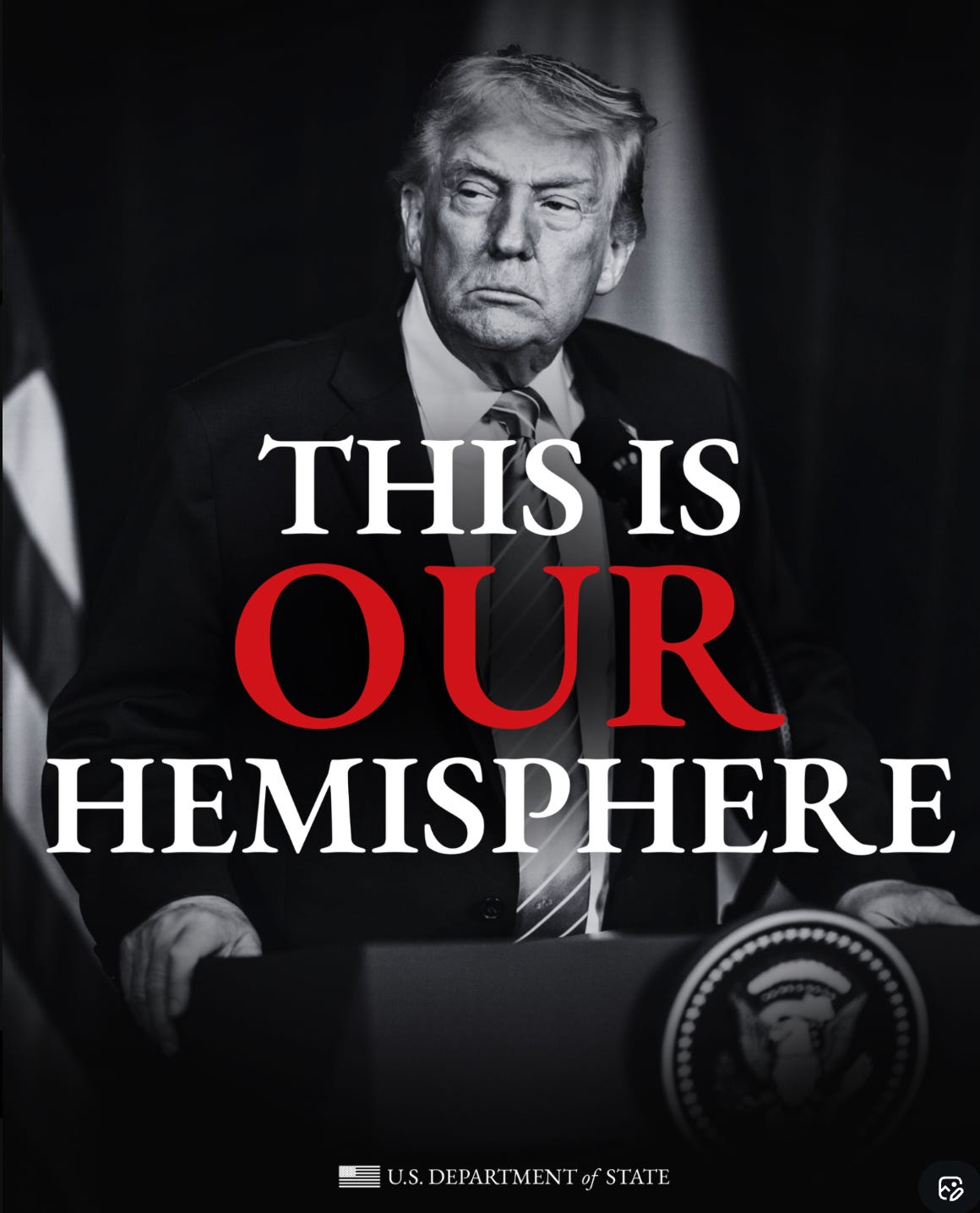
I think it is important to understand Trump’s actions in Venezuela as a singularly consequential historical inflection point—one that future historians may point to as marking the transition from one era to another. Think of the 1956 Suez Crisis, which exposed the fecklessness of the British and French empires and sparked a period of rapid decolonization; the fall of the Berlin Wall in 1989 and the dissolution of the Soviet Union; or the September 11 attacks, the response to which hastened the end of America’s unipolar moment and made way for China’s rise.
Trump’s moves in Venezuela, combined with the way in which his administration is justifying these actions, are likely as consequential. This time, however, the casualty of the transition may be the rules-based world order — potentially to include the United Nations itself.
Claiming dominion over an entire hemisphere — and then acting on it by deposing a foreign head of state to secure access to natural resources — is about as imperialist as foreign policy gets. It is also exactly the kind of behavior that the United Nations and the (formerly) U.S.-backed, post–World War II rules-based international order were created to guard against. There is now an open clash in geopolitics between the very foundation of the current international system, in place for the last 80 years, and a hegemonic power indifferent to that system.
A nakedly imperialist United States and a United Nations created to uphold a liberal international order cannot exist side by side. Something is going to have to give.
If I sound alarmist here, it’s because what’s happening is truly alarming.
