


![[Re]Group's avatar](https://substackcdn.com/image/fetch/$s_!w0DV!,w_108,h_108,c_fill,f_webp,q_auto:good,fl_progressive:steep/https%3A%2F%2Fsubstack-post-media.s3.amazonaws.com%2Fpublic%2Fimages%2F0517e9f8-af1c-41a5-b83c-2630660e4517_256x256.png)
UN week is here. Hundreds of presidents and prime ministers are headed to New York this week for the annual opening of the United Nations General Assembly. The presence of so many world leaders all in the same place at the same time makes UNGA the most important week of the diplomatic calendar.
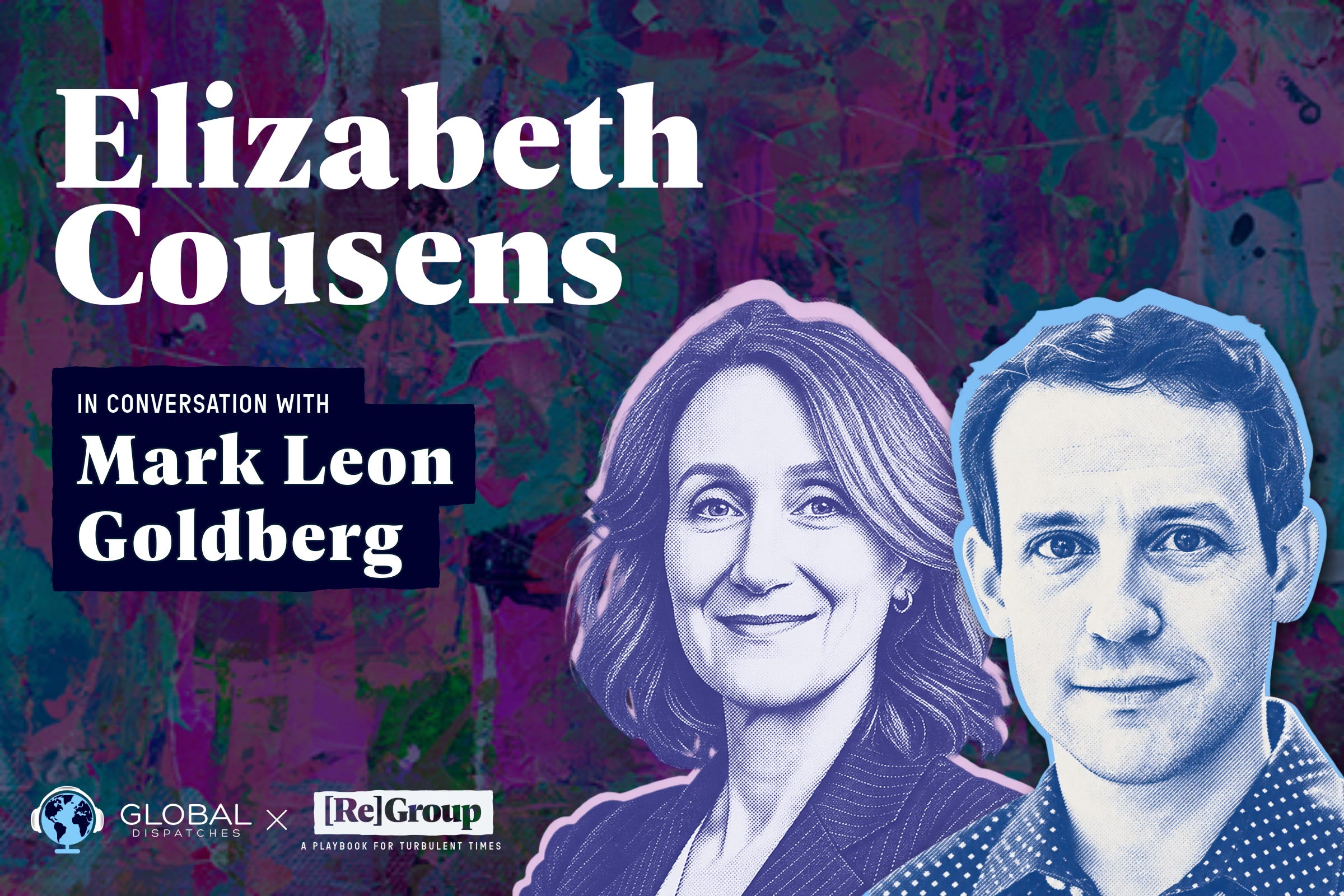
I’m joined today by Elizabeth Cousens, President and CEO of the United Nations Foundation who previews some of the key speeches, stories, trends and moments that will define UNGA81. We kick off discussing the leadership transition at the top of the United Nations before turning to some of the key issues she expects to drive the diplomatic agenda — including AI, Iran and and an international order teetering on the edge.
The episode is freely available on all podcast listening platforms, including Apple Podcasts and Spotify. It is produced in partnership with ReGroup Playbook.
To get episodes like this as soon as they are published, sign up for our mailing list
Transcript edited for clarity
Mark Leon Goldberg: Welcome to Global Dispatches. I am your host, Mark Leon Goldberg. I’m joined today by Elizabeth Cousens, the President and CEO of the United Nations Foundation. Welcome, Elizabeth.
Elizabeth Cousens: Great to see you, Mark.
Mark Leon Goldberg: So, I feel like this is an annual tradition at this point. This, I think, is the fifth year in a row that we’ve done this UNGA preview ahead of the big gathering at the United Nations.
Elizabeth Cousens: And we’re always excited every single year.
Mark Leon Goldberg: I get more excited every year. I don’t know about you. But this is a really great opportunity to speak with you, someone who knows the institution so well, about the big stories that you think that we think will drive the agenda in New York as hundreds of presidents and prime ministers all come to New York for the opening of the UN General Assembly. So, let’s kind of dive right into it.
One of the big stories this year is the race for UN Secretary-General. Antonio Guterres’ term expires at the end of the year, and succession process is already underway. We’re recording this on Thursday, September 17th in the afternoon.
Tomorrow morning, there is expected to be another straw poll at the Security Council to test the viability of the candidates. Just to kick off, what’s your assessment of the state of this race for Secretary General right now?
Elizabeth Cousens: Yeah, look, this is a wide-open race still, Mark. I mean, it’s late in the day. You would think when you had a once-in-a-decade transition, you would give yourself more than three months to make it. But in fact, I think it’s still a very wide-open race. The last two straw polls to date show that. And even if it starts to show some concentration tomorrow in the straw poll, we’re all eagerly awaiting.
It’s still early until it’s done. There are a lot of trends you can point to. There’s a lot of hypothesis about new candidates running, coming into the race at the 11th hour. All that is possible because this is one of those transitions that has very few rules that govern it. So, I think we’re in for some unexpected developments in the next coming weeks.
Mark Leon Goldberg: Well, what do you expect to happen at UNGA that might influence that race?
Elizabeth Cousens: Yeah, well, look, I think all the candidates, so far as we all know in our tracking, are going to be in town. They’re going to be holding lots of meetings and bilaterals to shore up support, to address any concerns they feel that particularly members of the Security Council might have. A number of them are showing up in very public events. Some of them are showing up in private events, so far as we can tell. So this is a really critical opportunity for them to build support. It’s also an opportunity for governments to sort of give some signals about what they’re expecting.
Look, I assume this is at least one item on the summit agenda for President Trump and President Xi. I hope it is. It’s a rare opportunity for them to speak personally about something that matters very much to both countries as well as the whole world. So, I honestly think that until we have a few more turns of the wheel, we’re not really going to know how this is going to land. And remember, when you cast straw polls, even to the point when they get color-coded, they aren’t yet. But once they start differentiating between permanent members of the Security Council and non-permanent members, votes can still change.
They’re essentially all anonymous. So, there’s a lot of signaling that happens in the voting at this stage. I think that is still more than throat clearing, but it’s not yet decisive.
Mark Leon Goldberg: So that’s interesting. Your take here, I think, accords with mine as well, which is essentially that up until UNGA, the process has fallen at very much below the heads of state level. And that UNGA is kind of like a forcing mechanism to inspire presidents of the Security Council, prime ministers, people like Xi and Trump to actually start thinking about this personally.
Elizabeth Cousens: Well, and the clock is ticking because Antonio Guterres leaves office on December 31st. And although, as you know, there’s also speculation about what happens if they haven’t chosen somebody, and could there be a caretaker? Again, all things are possible, but the pressure will really start to mount, particularly at a time when, you know, there’s mounting pressure for the UN to show up in strength and when there are so many giant issues on the agenda that really warrant the kind of problem-solving that the UN represents. So, I think we will see an intensification of all of this after UNGA, hopefully, not too long after UNGA, we’ll have an answer.
Mark Leon Goldberg: So, let’s talk about some of those other ideas and issues on the agenda. Like, what are some of the key stories beyond the sec-gen race that you’re going to be following this week?
Elizabeth Cousens: Yeah, well, obviously, the Middle East is a giant one. I think the war in Iran, the instability in the broader region is going to be on everybody’s radar, as are conflicts in other parts of the world that we’ve been talking about for too many UNGAs, whether it’s war in Ukraine, whether it’s war in Sudan, increasing tensions between Ethiopia and Eritrea are really ticking up. And I know that’s something you’ve done a lot of good journalism on. So that whole peace and security landscape is one.
The big issue, though, that seems to be dominating the agenda in a way that’s just taken off in literally the last week is AI. And there are all the obvious reasons for it, you know, really thoughtful and terrifying essays from the people who know the most about it. And even again, the U.S.-China summit is one where that’s going to be top of mind. So, a lot of energy is looking to how to solve for both the huge opportunities that AI clearly holds possible for people and the planet, but the tremendous risks if we undergovern it or we govern it late.
And so, I think that a lot of pennies are dropping on the AI front. And so you see not only a lot of AI events that were already on the agenda, but a crowding to get into those rooms and just a lot of concern that if you’re going to address something that probably has species-level risk attached to it, like the one place you can really bring all the threads together is a platform like the United Nations where everybody comes and has a voice and a seat.
Mark Leon Goldberg: Well, let me ask you about that a bit. I mean, it is actually, as you said, kind of stunning how quickly this has surged to the top of the agenda. Antonio Guterres gave his annual pre-UNGA press conference yesterday, addressed a lot of questions about AI. Like, what do you see as the UN’s role here in particular? And like, what has the UN been doing to that end?
Elizabeth Cousens: Yeah, look, I think the UN was actually ahead of the curve on AI. You remember a few years ago, they created that high-level advisory panel on AI. They had a lot of really interesting thinkers across public and private sectors — academics and others to start — to just articulate, you know, an agenda that needs collective consideration, right? It doesn’t have to be at the UN, but they were trying to shape that a bit. And then, coming out of the Pact for the Future last year, two initiatives were launched.
One, a scientific panel on AI, which is some people analogize, they say it’s like the IPCC for AI, but to create a bit of a knowledge base that can be shared so we all can kind of have a prayer of catching up with the science, as well as a global dialogue on AI where more political and policy issues could be explored. I think both of those are important instruments.
The one thing I would say, there’s a lot of nervousness among some countries and definitely some private sector actors about the UN taking too many liberties around these questions, right? And that goes back a long time, not just with AI, but technology in general. But I think there’s a little bit of fear-mongering around that. I mean, what the UN can really be at the end of the day is the place where countries, where companies, where citizens, where stakeholders can actually show up and try to think their way through really challenging problems that impact all of us.
It doesn’t mean that control is going to be vested in the UN. It doesn’t mean that the UN has to have some unwelcome kind of governance role. But it is a unique forum in which everybody can raise their fears and concerns and try to have a grown-up conversation about really tough challenges, not just globally, but that are playing out for everyone nationally and locally.
Mark Leon Goldberg: And on Iran in particular, you know, we’ll have Pezeshkian speaking, we’ll have Trump speaking, we’ll have Netanyahu speaking. What do you expect to come, not necessarily out of these speeches, but out of the fact that so many of the key players are at least in the same city at the same time, if not the same room?
Elizabeth Cousens: Well, I’d love to say and hope that there might be side conversations of a wide variety of kinds that could maybe try to, again, find some pathways toward resolution or de-escalation, if I can put it that way. I’m not sure we’re going to get that. One thing you can kind of guarantee from leaders’ speeches is that they tend to be theatrical. So, there’s a little bit of that that happens. Obviously, that’s true every UNGA.
But I hope that respective teams, and obviously all the regional diplomacy that has been going on so intensively since this war started, there is that opportunity when you’re at the General Assembly for all kinds of conversations to happen because everybody’s in the same place. So, I hope maybe in the corridors and in the side rooms some of that gets advanced because it needs to.
Mark Leon Goldberg: So, beyond AI and Iran, are there any other key events or storylines that you’ll be following with particular closeness?
Elizabeth Cousens: Yeah, well, a couple to just put on the radar. And obviously, there are many, because it’s a very crowded, crowded agenda. But one, and you’ve called attention to this in some of your own reporting, the high-level meeting at the end of the week on pandemic preparedness, I think is, you know, many people stop focusing on UNGA before you get to Friday. But this is actually a really important event, especially after the signing of the pandemic agreement earlier this year, where there still are some really thorny outstanding issues.
This is an opportunity to try to make some headway, build some momentum to resolving them. And it’s so critically important. I mean, you would think there hadn’t been a pandemic several years ago. The people kind of have dropped off the agenda. It’s really important to make good on that promise of being better prepared for the next time. So that’s one that I’m also watching. It’s one that a lot of our teams are very, very involved in.
The other theme that I think you’re going to see a huge amount kind of rippling through both thematic topics and in general is this whole question of does the UN and multilateralism have a future? What does international cooperation look like in a fragmented world? What’s the role of middle and pivotal powers? There’s going to be a lot of those kinds of themes, I think, both in meetings that are dedicated to that proposition, but also just circling throughout because people are looking at a dramatically changed, I mean, we’re living through a dramatically changed geopolitical landscape.
It’s never going to look like it used to look. It’s obviously changing in some very specific ways. And that’s scary in one way, but it also creates a lot of opportunity for very different leadership to emerge, different configurations in ways that can be very, very productive. I think that’s what a lot of people are also going to be looking to, where those signs and signals are cropping up with an even more kind of practical effect.
Mark Leon Goldberg: Yeah, I think that’s like, at least to me, one of the most crucial points about this UNGA in 2026 in particular is that, for many years, we’ve been talking about how the international system has been eroded or chipped away, how liberal norms have been diminished steadily over the past few years or decades even. But it seems that that pace is accelerating and that we’re kind of facing this real crisis point in the international system. And I wonder if that imbues particular significance on this particular UNGA.
Elizabeth Cousens: No, I think it absolutely does. We could have a much longer conversation about the history and the drivers of the moment that we’re in, and more than we probably have time for today. In my view, a lot of what has broken open in the last year was already in the making many years before for a whole bunch of different reasons. But we have, in my view, have passed an inflection point. I mean, this isn’t about sort of restoring where we were from 1990 to the present.
It’s a little bit more, actually, like the bulk of the UN’s history. I think we’re in a moment that is more comparable to essentially the main 40 years of the UN’s first decades, which was very conflictual, fraught with rivalry, really hard to get agreement around things. The Security Council was often stuck. And yet some of the UN’s best moments and greatest contributions to international peace and security and to international kind of progress and human betterment happened during those years.
So, I think there’s a lot of value in looking back at some of those times when we think that we may never be able to get anything else done, you know, in a multilateral context again, because we’re riven again. There are lots of different dynamics and lots of disagreements. And, again, you and I have often talked about this — The UN isn’t a place where people come because they all agree. It’s a place where people can come to work through their differences. And it’s natural that countries have very different interests in their regions and on the world stage.
The UN is a place where they can try to work through some of that. But it’s certainly a challenging environment. Look, I also want to say we just came out this morning; you may have seen it with a global poll that we just released that looked at these questions of international cooperation, the future of the UN, and the Secretary-General race. We looked across 20 countries representing 56% of the world’s population, so four and a half billion people, including, by the way, all Security Council members.
And there is remarkable strength and commonality of view. Global publics want strong leadership and international cooperation. They want it to be effective, and they want a UN that delivers in a way that can support a safer, healthier and fairer future for them. So, I was really struck that an overwhelming majority, 86 percent globally, believes that the UN remains a necessary instrument to work through the turbulence that every country and citizen is facing today. They see that it can struggle to deliver, so they’re clear-eyed about that. But the tiniest minority, only something like 12%, sees the U.N. as an outdated institution. That’s really, I think, compelling.
They have a very clear view about what they want the UN to work on. And they have very clear views about what kind of secretary general they think should lead it. By the way of that, a significant majority would like a woman to be that person. But I think that says to me that we are in this tumultuous time. Global publics clearly recognize it, and they see the very concrete ways that tumult manifests in their daily lives. And they want to see stronger international cooperation and more effective UN to help deal with that.
Mark Leon Goldberg: You know what’s fascinating about the poll that you put out is how it coincides and supports several other recent polls as well. There is one from Pew that was put out last week that surveyed publics across many dozens of countries. One from Rockefeller, I think, that was put out very recently, yesterday. Yeah.
And they’re all just collectively tell that same story that you said that despite a lot of the sort of problems that the UN is seemingly unable to solve, people around the world still look to the UN to solve those problems.
Elizabeth Cousens: And they look to their leaders to be prepared to cooperate to solve problems. That, to me, there’s a really interesting link up between the global implications and the domestic political ones. And publics see that link really clearly. I think convincing their leaders to see it clearly is something that maybe we still have some work to do. But that, to me, is a really powerful indication that if leaders want to deliver for their citizens, one way to do it is through more effective cooperation, including at the UN.
Mark Leon Goldberg: So, you know, I feel like a lot of people maybe outside the UN bubble don’t realize this, but UNGA 81 is not just a week in September. It is the first two weeks of a year-long session of the General Assembly. I’m curious to learn from you, I suppose, two things. One, how do events this week set up the UN’s work for the rest of the year? And for the rest of the year, what are some of the key moments and debates that you foresee shaping the United Nations in the coming year until next September?
Elizabeth Cousens: Yeah, well, you stole one of my lines, which is it’s not just a week, it’s what happens the next day and the day after that because the General Assembly runs for a year until the next one starts. So, the whole calendar of what happens across the year, look, I think the SG transition will loom large because there’ll be everything from kind of closing out and thinking about the legacy of Antonio Guterres as he departs the UN at the end of this year.
We’ll be looking at how the baton gets passed on UN reform. The last year has been a very intensive year of internal reforms largely at the UN, restructuring, budget cutting, etc. So, how does the baton get passed into the next year and maybe lifted to another level? We’re looking down the barrel at the last few years of the Sustainable Development Goals and the 2030 agenda, and there’s a summit next year on that issue. So that’s going to be a big topic that a lot of delegations are going to start getting their hooks into over the course of this year.
And then everything, honestly, around AI, I do think is going to continue to be a really dominant theme, including because we have the second year of this global dialogue that I mentioned. And just because the pace is putting it on our agenda, whether we want it to or not.
Mark Leon Goldberg: So lastly, bringing it back to high-level week, are there any particular speeches on your radar? Any individuals you’re kind of keen to see what they have to say?
Elizabeth Cousens: Yeah, well, I think obviously we’re looking to the three you mentioned earlier are going to be very interesting ones.
Mark Leon Goldberg: That’s Trump, Netanyahu, and Pezeshkian
Elizabeth Cousens: That’s trauma right there.
Mark Leon Goldberg: Yeah.
Elizabeth Cousens: But I’m actually really keen to hear Prime Minister Burnham’s speech, I think, as a politician, newly in office with a primarily domestic orientation in his agenda, and how he threads the needle between that and showing up at the UN. Very interested in President Macron as well. I mean, he’s always got very strong speeches. This will be his last at UNGA. President Lula, I would expect to be nothing other than a stemwinder. I often look to some of the smaller countries, or just countries that aren’t those dominant ones, sometimes on the first day for some of the most interesting speeches.
Mia Mottley never disappoints. President Ruto, I think, never disappoints. This will be Japanese Prime Minister’s inaugural run. That will be really interesting. Zelensky will be. So, there’s a lot. I mean, there are a lot of folks showing up. And I know sometimes people say, “Oh, why isn’t President Xi and President Putin showing up?” They haven’t for a decade, so I wouldn’t read too much into that. And both of them in different ways very much invest in the UN, as we know.
Mark Leon Goldberg: Anything else you want to mention before I let you go?
Elizabeth Cousens: I don’t think so. For anybody who’s listening, I just think this is such a consequential time. And it’s not just for the UN. I would say the following. The UN is sometimes there’s a conflation between what it was created for and all the different instruments and things that it does in the world. We often mush it together. I think there’s challenge to all the instruments, but right now where the real challenge lies is to that core idea that countries get more out of committing to cooperation than they do to falling asunder.
And I think anything that we can do to shore up that basic proposition and to demonstrate that it’s in the interests of countries worldwide is something that’s on all of our agendas, frankly, not just next week, but in many of the weeks to come.
Mark Leon Goldberg: Well, Elizabeth, thank you so much for your time. Good luck this week.
Elizabeth Cousens: Thank you. I’ll look forward to seeing you around and about.
Mark Leon Goldberg: I’ll be around and about, as I know you will be as well. And just a programming note, be sure to follow [Re]Group as well. This is a partnership with the UN Foundation’s Substack, [Re]Group, and Global Dispatches. We’ll be bringing you lots of content throughout the week. Thank you, Elizabeth, and thank you all.
Elizabeth Cousens: Thanks, Mark. Great to see you.
Mark Leon Goldberg: Bye.


![[Re]Group's avatar](https://substackcdn.com/image/fetch/$s_!w0DV!,w_96,h_96,c_fill,f_webp,q_auto:good,fl_progressive:steep/https%3A%2F%2Fsubstack-post-media.s3.amazonaws.com%2Fpublic%2Fimages%2F0517e9f8-af1c-41a5-b83c-2630660e4517_256x256.png)


