


The ripple effects of the Iran conflict may help unleash a new civil war in Ethiopia.
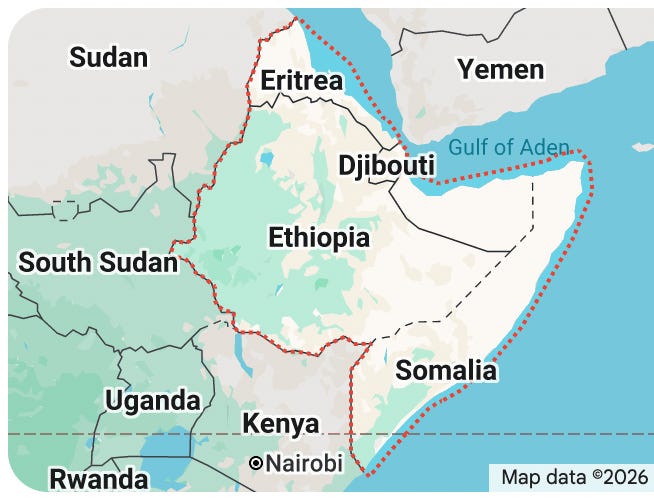
Here is the connection: A group of rebel factions in Ethiopia’s northern region recently formed an alliance against the federal government. This alliance, led by the Tigray People’s Liberation Front, is backed by the government of Eritrea.
Eritrea has long been an international pariah. It is sometimes referred to as the North Korea of Africa for the sheer degree of repressive control the authoritarian state exerts over its population. Even in a region known for bad governance and human rights abuses, Eritrea stands apart.
The Biden administration slapped sanctions on its government for its role in a brutal civil war in Ethiopia from 2020 to 2022. But Eritrea is suddenly quite important to the Trump administration. The country sits across the Red Sea from Yemen, where Houthi rebels are now threatening international shipping along a route that has become more valuable as traffic through the Strait of Hormuz has been throttled. With a keen eye on needing Eritrean support to ensure that the Bab el-Mandeb Strait does not go the way of Hormuz, the United States, on September 18, lifted sanctions on Eritrea, including its military.
Just two days later, this new alliance was formed, and intense fighting has since broken out in northern Ethiopia.
The Ethiopian government accuses Eritrea of backing these rebels, which is a reasonable assumption and is supported by evidence. Despite the fact that Eritrean and Ethiopian forces fought alongside each other against Tigrayan rebels in the previous civil war, the Tigrayan forces and Eritrea have since made amends. Meanwhile, tensions between Eritrea and landlocked Ethiopia have been building in recent years, as the Ethiopian government has made clear that it has designs on gaining access to Eritrean territory on the Red Sea. Eritrea and the Tigrayan factions have now found it convenient to have a shared enemy in the Ethiopian government.
The recent aggression by the Tigrayan-led rebel group is fueled by the fact that it can now rely on external support and a steady flow of arms from a government no longer under sanctions — and, in fact, one whose cooperation is needed to keep vital shipping routes open in the Red Sea. Meanwhile, other outside forces, including Egypt, Sudan, and the UAE, are fueling chaos across the Horn of Africa region.
To understand why this is so dangerous, it helps to remember what happened the last time Ethiopia descended into war.
From 2020 to 2022, the Ethiopian government fought a brutal war against the Tigray People’s Liberation Front, which had long been one of the most powerful political and military forces in the country. Eritrea joined the Ethiopian government in that war and sent its own forces into Tigray.
The conflict became the deadliest war of the 21st century. Hundreds of thousands of people are estimated to have died, with some estimates putting the toll at around 600,000. Most of those who died were civilians who succumbed to starvation and other deprivations of war. That war formally ended with a peace agreement signed in Pretoria, South Africa, in November 2022. But many of the underlying disputes were never fully resolved — and now the pressures stemming from the war in Iran have introduced a new variable, adding to the danger.
This conflict is also drawing in many other countries in the region, including Sudan, Egypt, and Somalia. If a full-blown civil war erupts in Ethiopia, it could become one massive, interlocking regional conflict, pitting various factions and their outside supporters against one another. For example, Egypt and Eritrea back the Sudanese Armed Forces in their war for control of Sudan against the Rapid Support Forces, which are in turn supported by the United Arab Emirates and Ethiopia.
Because the stakes of this conflict are so high — both in terms of the sheer number of people whose lives could be lost or upended and the potential for a wider regional war — I wanted to take podcast listeners in depth with a conversation with someone who knows the region and the conflict dynamics driving this situation.
I speak with Dr. Jalale Getachew Birru, the East Africa Regional Expert with the conflict-monitoring nonprofit ACLED, who explains the complicated web of factions and alliances driving Ethiopia toward a full-scale civil war. Our conversation is a timely explanation of this incipient civil war — and what, if anything, can pull the fighting back from the brink.
I publish Global Dispatches to help those who care about people and places normally overlooked by Western media better understand the forces shaping their lives, and why events in one part of the world can have consequences far beyond it. The unfolding conflict in Ethiopia is well worth putting on your radar.
Our conversation is free for all. You can find it on Apple Podcasts, Spotify, or wherever you get your podcasts. You can also support my work using the buttons below.


