



We are down to the wire in the race for UN Secretary-General, as seven candidates vie to lead the United Nations. They are a diverse group of diplomats, but one thing unites them: each has made revitalizing the UN’s role in peacemaking, conflict mediation, and conflict prevention a priority of their campaign. This reflects a broad recognition that the UN’s role and influence in these areas have waned in recent years.
So what can be done to restore the UN as a more meaningful player in global peacemaking? And what can the next Secretary-General personally do to promote peace and bring conflicts to an end?
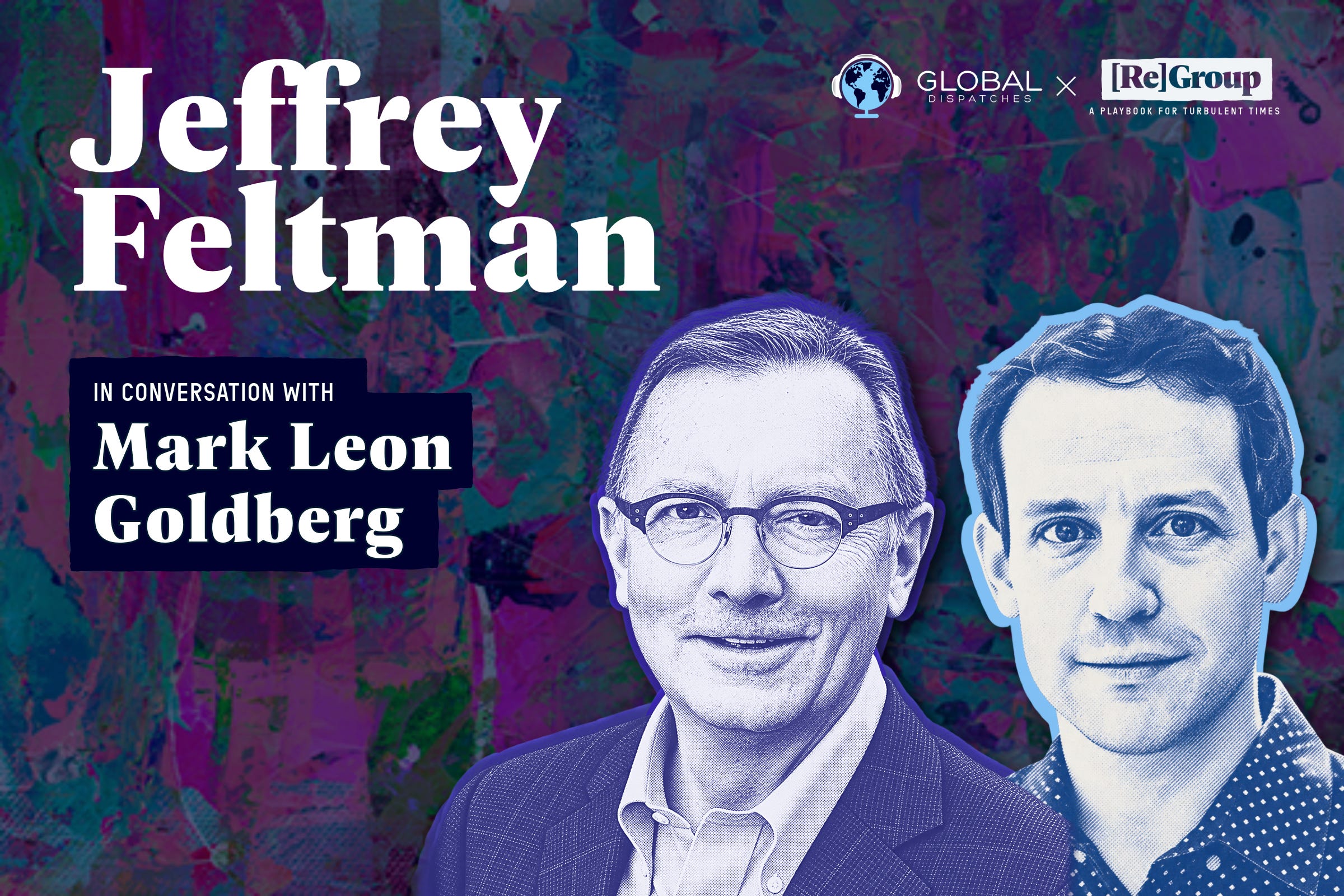
I’m joined today by Jeffrey Feltman, a longtime diplomat who served as the UN’s Under-Secretary-General for Political Affairs and is now a senior fellow at the UN Foundation. We kick off by exploring why the UN has seemingly become less effective in conflict mediation and peacemaking in recent years. We then discuss concrete steps the next Secretary-General can take to revitalize the UN’s role in peacemaking and conflict resolution, some of which Feltman outlined in a recent piece for [Re]Group.
Our conversation is freely available here on Substack. An audio-only version will be published to the Global Dispatches podcast on Monday. You can find it on Apple Podcasts, Spotify, or wherever you get your podcasts. This episode is produced in partnership with [Re] Group — A Playbook for Turbulent Times, a Substack from the UN Foundation.
Transcript edited for clarity
Mark Leon Goldberg: Welcome to Global Dispatches. I am your host, Mark Leon Goldberg. I’m joined today by Jeffrey Feltman. Thanks again for joining, Jeff.
Jeffrey Feltman: It’s great to see you, Mark, and I look forward to the conversation.
Mark Leon Goldberg: So, by way of introduction, Jeff, you are a longtime American diplomat. You served as U.S. Ambassador to Lebanon, as the Assistant Secretary of State for Near Eastern Affairs, and also as an international diplomat. You served as the United Nations Under Secretary General for Political Affairs. I sort of liken that position to something akin to the UN’s Secretary of State or the UN’s Foreign Minister. How would you describe the role of the Under Secretary General for Political Affairs?
Jeffrey Feltman: Mark, I’m smiling because that’s how Ban Ki-moon, when he swore me in July of 2012, that’s how he explained the job. He said, “Mr. Feltman, you are like the Hillary Clinton,” who was then Secretary of State, “for the UN.” And I kind of looked around and I wondered, “Well, where’s my limousine? Where’s my protective detail? Where is all my staff?” But anyway, yeah, so the job is really dealing with the political relationships.
It’s not the humanitarian, it’s not development. It’s the political side, including conflict prevention, management, and one hopes, resolution. So yeah, and it was a great job. It was my favorite job of my whole career. And I tell you, even though you could say I was a political appointee, I got the job because I was a U.S. citizen, the United States was insisting that an American have that job, I took my oath of office on the charter in good faith. And neither the Obama administration nor the Trump, the first Trump administration, which were the two administrations that were in office when I was at the UN, ever put that at risk. They treated me appropriately as a UN official, and I was very proud of that.
Mark Leon Goldberg: So that’s all good background, and you mentioned your role was really on the political side, the conflict mediation, conflict prevention side. And I’m glad we’re speaking today, Jeff, because we’re in the midst of a real transitional period at the United Nations as UN member states choose the next secretary general. There are, really, a diverse set of candidates for the job right now, but one thing that unites most of them in their campaigns is that they seek to prioritize the revitalizing of the UN’s role on peacemaking, on conflict mediation, on conflict prevention, which I think reflects the broad sense that the UN’s role and impact in this area has waned in recent years.
I would be curious to learn your perspective on why the UN has seemingly been less impactful in conflict mediation and peacemaking. What’s your diagnosis here?
Jeffrey Feltman: Well, I mean, Mark, I think that it’s worth remembering though that the UN was set up primarily to prevent World War III, and that hasn’t happened. I mean, World War III has not happened.
Mark Leon Goldberg: By that metric, the UN has succeeded. I do say that to audiences that I speak with.
Jeffrey Feltman: Yeah, exactly. Of course, we know what’s happened. We have paralysis in the Security Council, not for the first time. There was paralysis in the Security Council during the Cold War, too. But the paralysis this time is a bit different. There’s also, member states don’t want to be on the Security Council agenda. Who wants to be, have that Security Council spotlight?
So when you have a conflict that’s brewing, it’s hard for the UN to get momentum in the particular country ‘cause they say, “Yeah, go away. We don’t want you there.” And I found when I was Under Secretary General for Political Affairs that our best key to getting into a place was saying, “We’re trying to keep you off of the Security Council agenda. We’re trying to prevent or help you resolve a conflict so the Security Council doesn’t have to think about it.” And there are quiet examples where the UN has continued, despite the polarization, to play a quiet role in helping to deescalate tensions that could have erupted into violence.
I can think of a couple that happened during my time. But right now you have Security Council paralysis. You have the current Secretary General, António Guterres, I think has taken a cautious approach to peace and security matters because of the polarization, because of not wanting to exacerbate differences or animosity among the great powers. But I left this year’s High Level week at the UN, the UNGA week, encouraged because I felt that there was universal backing for having the UN sort of revive a stronger peace and security role.
The UN played peace and security roles even during the Cold War when there was polarization, and I’m convinced that, that the UN can do more now. It’s not like the UN’s absent, but what the UN has been doing is playing a more quiet role, which is appropriate in some conflict situations, but in other places, I think you need to have a much more visible presence to elevate and amplify the issues.
Mark Leon Goldberg: And so to that end, you have authored a recent piece on Re[Group], and I should say you’re a senior fellow at the United Nations Foundation. And this conversation is produced in partnership with Re[Group], which is a Substack from the UN Foundation. On that Substack, you identified some concrete ways that the United Nations can elevate its peace and security portfolio, and the incoming secretary general, whoever she or he might be, and the steps that she or he can take to revitalize the UN’s role in peacemaking, in conflict mediation. Let’s just talk through some of your suggestions. What is your top suggestion?
Jeffrey Feltman: Well, for the article that you mentioned, I focused on Sudan because Sudan’s the largest humanitarian and displacement crisis in the world. It’s one where there is a Security Council mandate already. But it’s one that I don’t think has gotten the global attention. So, the basic idea that I have is that the Secretary General may not, in the immediate term, be able to solve a crisis like Sudan, but the Secretary General can force the issue on the world’s agenda.
The Secretary General, by using convening power, using the power of appointment, using the ability to talk to the Security Council, can make it hard or impossible for the world to ignore this problem. So, a lot of the ideas that I expressed in the interview, um, that, that you mentioned were about how you elevate Sudan on the international agenda in a way that can lead to steps for de-escalation and things like that.
And even since that interview, I think there’s been even more urgency to the UN playing a role in this region because you have escalating tensions between Ethiopia and Eritrea. They were there when I did the interview, but I didn’t talk about it. And you already have Sudan in a civil war. You have war across the Red Sea. You could have a contagion of violence that goes on both sides of the Red Sea, interrupting global commerce, causing mass displacement that’s even worse than now.
And the Secretary General needs to basically keep this issue on the front burner. I don’t think that Sudan leads the same sort of polarization you would see in Gaza or Ukraine or in Iran.
So I think that this is one where the Secretary General has the ability to take the initiative in a way that can have a positive difference. Part of the problem with Sudan has been that there’s, obviously, there’s a civil war. There’s front lines in the Kordofan region in Southern Sudan. You’ve got the country basically divided among two warring parties with other insurgent groups even complicating it beyond that.
But the humanitarian access has been wanting. Both sides are using permits for humanitarian access to deny life-saving aid to those in need. The Secretary General can start calling this out in a way that makes it more difficult for others that have influence to stay silent.
Mark Leon Goldberg: So is it a matter, therefore, of the Secretary General simply being more vocal, doing sort of the personal shuttle diplomacy herself or himself in ways that we have not seen from a Secretary General in recent years?
Jeffrey Feltman: Yeah. Yes, I think so. And of course, I’m talking basically about how you try to elevate this on the international agenda. You had a great piece yesterday that keeping it on the international agenda is not sufficient. We need to find ways to solve this. I fully subscribe to your recent piece, Mark, and I’m talking more about, at this point, just getting it on the international agenda. Let me take an example.
Antonio Guterres, in December 2023, the Secretary General, went to the Egyptian side of the Rafah Border Crossing, and with a lot of media visibility, demanded the Israelis to let the humanitarian assistance go in, and it was the right thing to do. It made the Biden administration very uncomfortable. It should have. Obviously not uncomfortable enough. I think they should have put more pressure on the Israelis when it came to humanitarian assistance to Gaza.
But the Secretary General did the right thing. He brought the world’s attention to that issue in a way that I think helped ease some of the restrictions on the humanitarian side. I wish he’d done the same thing with Sudan. I wish he had gone to Chad, to the Adre Border Crossing between Chad and Darfur, which the Sudanese Armed Forces do not control. But the Sudanese Armed Forces representing the recognized government of the United Nations said to the UN, “You can’t use that border.
You can’t.” Even though they weren’t physically there, they bureaucratically denied access across the border to get life-saving humanitarian assistance into Darfur. I wish the Secretary General had done the same thing he had done in Rafah, that he had gone to Adre with media and made it very uncomfortable for the Sudanese Armed Forces and their backers to continue that blockade. These are the sorts of things I think that can get attention and have an impact.
Mark Leon Goldberg: Let me maybe just play the devil’s advocate here a little bit because I agree with your diagnosis here. But I do wonder, again, playing the devil’s advocate, if you have a Secretary General who is very visible, very out there, and expending a lot of political capital to solve this complex crisis in Sudan, or even elsewhere, and the conflict is not resolved, what happens then? Does she or he therefore, having expended all sorts of political capital on this particular crisis, therefore, have not much juice left to do the other things that she or he needs to do around the world?
Jeffrey Feltman: I think the Secretary General needs to be caught trying, and the risk of failure is always there. Probably one would fail more than one would succeed in trying to resolve some of these terrible conflicts, but that is the role of the Secretary General. Now, the other thing you can do is have very high-profile envoys. Not every conflict needs a high-profile envoy. Some conflicts, as I said earlier, need quiet diplomacy.
But for something like Sudan, you have a very good envoy right now. Pekka Haavisto, the former Finnish Minister of Foreign Affairs, Minister of Development, presidential candidate, and he knows the region quite well. But he’s a personal envoy of the Secretary General. He doesn’t have a Security Council mandate. You could have the Secretary General put options before the Security Council on creating a mandate that would make him a special envoy with a mandate, budget, and staff to be able to do the job.
And then the envoy absorbs some of the risk from the Secretary General. So I think that part of the new Secretary General needs to think strategically about the appointments process. Who can keep attention on a particular conflict issue, who has the credibility with not only the parties in the conflict, but those that are backing them, and can absorb some of the risk of potent-of potential failure for you.
Mark Leon Goldberg: So, another idea on your punch list of things the UN and the Secretary General can do to revitalize the UN’s role in peacemaking and conflict mediation is that you propose something akin to an Helsinki process for the Middle East. Can you just flesh that out what you mean and then remind listeners, who are not familiar with the Cold War era Helsinki process, what it accomplished and why it ought to be potentially a model for dealing with the Middle East right now, including Iran?
Jeffrey Feltman: Yeah, the Helsinki process, as you say, it was a Cold War initiative, started in Helsinki 1975. It developed eventually into the Organization for Security and Cooperation for Europe, which still exists. The OSCE still exists. It’s Vienna-based. But basically, it was functional security architecture that was built even among enemies. At the height of the Cold War when Moscow and Washington were nuclear-armed to the hilt against each other, they and their allies, their partners on each side, I would say partners on the Western side and the sort of Warsaw Pact subservient partners-
Mark Leon Goldberg: The clients on the other side. Yeah
Jeffrey Feltman: ... clients on the other side. Thank you. That was the word I was looking for.
Mark Leon Goldberg: Yeah.
Jeffrey Feltman: But in any case, it was an inclusive process that came up with ways to deal with the security problems of Europe at a time when there was no trust and it was between sworn enemies. Now, on the Gulf, and the current Iran war, I don’t see the United States turning to the United Nations to say, “Solve this war for us right now.”
I don’t see Iran doing it either. But there’s nothing stopping the UN from starting to talk about the day after. Because when this war ends, however this war ends, there’s gonna be deep mistrust, deep mistrust across the Gulf itself, deep mistrust between the Iranians and the United States. But I don’t think anyone’s going to want to see this to see a war reignite because of an accident. So can you taking the model of the Helsinki Accords, where you had sworn enemies sitting across the table from each other, they come up with security framework and sort of rules of the road, can you start to do that with the Gulf or Middle Eastern countries?
I would start with the eight littoral countries and their respective allies that are along the Gulf, which are the six Arab Gulf states plus Iraq plus Iran, to come up with, say, an incident prevention and response mechanism. Can the UN help these countries design some way that would prevent an accidental war because of miscalculation? How do you deal with maritime incidents? How do you deal with accidental violation of airspace?
How do you convey intentions? Can you have a understanding about large military exercises that would be announced in advance or something like that? The UN can start to talk about the day after, and how you would build a security architecture to minimize conflict. Now, I’m not talking about some grand principle thing. I’m talking about you start off with, again, incident prevention and response.
Mark Leon Goldberg: Can I ask, like, why the UN here? Because you already have like the Gulf Cooperation Council, which I know doesn’t include Iran necessarily. You already have Gulf countries that have diplomatic relations with each other. Why would it take, like, the United Nations with its 193 member states to be the architecture around which a platform, as you imagine, would coalesce?
Jeffrey Feltman: The reason why I think the UN should get involved in this is because of the principle of inclusivity that governed Helsinki. Now, the Helsinki process was not a UN process. But in the case of the Middle East, there are lots of Track 1.5dialogues, which means... Track 1.5 dialogue is when officials come together in a non-official capacity. There’s lots of Track 2 dialogues where people get together in sort of personal capacity, not officials, to talk about things, that are already sort of talking about this.
I’m not breaking new ground in talking about a Helsinki-like process for this region. But the problem is, in these Track 1.5 and Track 2 dialogues, these unofficial dialogues, inclusivity gets set aside. Like, some countries will say, “Yes, we need to have a Helsinki process, but no way can we do it with Iran.” Or others will say, “No way can we do it with having the Israelis around,” even though the Israelis also can contribute to war or peace in this region.
And so the UN can operate with the principle of inclusivity, bringing everyone together because everyone’s already a member state. Everyone has sovereign equality under the UN Charter, and so it makes it easier for these countries to get together that might otherwise try to exclude someone that needs to be in the room.
Mark Leon Goldberg: So, another one of your priorities that you recommend the next secretary-general embrace is to take steps to revitalize international humanitarian law, the laws of war, which frankly, over the last several years, have been violated at seemingly an increasing clip. I mean, we know it’s one of the real shames over the last decade or so is the just constant ignoring of international law in how militaries conduct their warfare throughout the world. But what can the UN do, if anything, to re-strengthen the Geneva Conventions and other aspects of international humanitarian law? And why is that particularly an important priority for the next secretary-general to focus on?
Jeffrey Feltman: Well, I think it’s part of the peace and security elevation that we’re talking about is to revive interest in and commitment to international humanitarian law as part of civilian protection, as a part of basically the rules of war, the rules of conflict to try to minimize the impact on civilian life. I think that’s an important part of peace and security agenda for a new secretary-general.
And this is one where there’s a great group of countries that’s already been working on this. It’s one where the secretary-general can walk in and embrace the existing initiative. In 2024, Brazil, China, France, Kazakhstan, South Africa, and Jordan, with the ICRC, which is the International Committee of the Red Cross sort of the holds the international humanitarian law, and these countries came together and started a global initiative on reviving political commitment to the international humanitarian law.
A hundred and twenty-seven countries have signed up for this already. So it’s something where the secretary-general has a great group of countries that can back his or her commitment to international humanitarian law because they’re already starting that. And there’s a meeting in Amman. There’s a global, a high-level meeting on humanity and war by this group in Amman in December. They will come up with recommendations, presumably sensible recommendations. They are not rewriting or reopening humanitarian law.
It’s an important distinction. So, no one’s asking for additional commitments from member states. They’re asking for reviving political commitment to the existing Geneva Conventions. And so the secretary-general coming into office, presumably on January first, will have a fresh set of recommendations from an active group on international humanitarian law to make his or her own. And you apply it back to Sudan. Sudan, the largest humanitarian crisis in the world. You make it clear that humanitarian access and other aspects of international humanitarian law are the focus of the UN when they’re looking at Sudan.
Mark Leon Goldberg: I guess I do wonder, again, maybe to play the devil’s advocate a little bit, is how much power the secretary-general has to enforce political commitments on international humanitarian law. I mean, it seems not that much. So, what else can she or he actually do to convince governments around the world not to bomb civilians?
Jeffrey Feltman: No, you’re absolutely right. I mean, he or she doesn’t have any absolute power in this way. But man, he or she should be able to embarrass countries, make it hard for countries to ignore this. I mean, there has been a real sharp deterioration in compliance with international humanitarian law, whether we’re talking about bombing of ambulances or what have you. And the secretary-general can make it harder for countries to ignore this deterioration.
Basically, I think that the secretary-general, on the whole peace and security side, primary task is to make it harder for others to stay silent.
Mark Leon Goldberg: So lastly, I wanted to ask you about potential for the secretary-general or her or himself ,and the UN more broadly, to become more deeply involved on questions around artificial intelligence and security, and the intersection of AI and international security issues. When we started our conversation, you mentioned the kind of mood around the United Nations during High Level week, during UNGA, as being somewhat optimistic about the UN’s ability to actually tackle some of these problems, which I note is a shift from the kind of general mood in previous years.
And one of the central things that happened at the UN during UNGA this year was this meeting of the Security Council featuring Sam Altman, Dario Amodei, and other AI leaders, and also people in the civil society space who are kind of warning about potential dangers of artificial intelligence. But this is a technology that’s firmly in the private sector hands right now. So what can the UN and the secretary-general her or himself do to advance safety issues around artificial intelligence in a way that would have like a meaningful impact in the real world?
Jeffrey Feltman: Mark, you mentioned High Levelweek, and one of the things that struck me, and I’ve been, like you, to many, many High Level weeks. One thing that struck me about this year’s High Level week was that the informal agenda, what everyone wants to talk about in the corridors over dinner, pull aside and things like that, and the formal agenda were unusually aligned. And AI was one of those issues that was both on the informal agenda, everyone wanted to talk about it on the sides, and it was also part of the formal agenda at the UN, including the Security Council meeting that, that you mentioned.
So I thought that was interesting because often the informal agendas and the formal agenda High Level week aren’t the same. And it was June or July, you had the global dialogue in Geneva, and then on artificial intelligence, and there is the-
Mark Leon Goldberg: And that was like a UN umbrella convened meeting that took place. It was an example of the UN’s inclusivity. It was a meeting about artificial intelligence that included most of the world and the developing world in particular, which are typically kind of excluded from these conversations.
Jeffrey Feltman: That’s right. And the next global dialogue of this convening is in May. And so the new Secretary General will be there. I think it’s important that you keep this global dialogue, which is, as you say, based on inclusivity, from becoming another GA, from becoming another one of these talk shops. And I think one way to do that is to focus on specific issues like health, like child safety, things that people can agree on.
So part of the UN’s role in AI is that global dialogue that’s a member state issue and has the risk of just becoming a talk shop. But I think the Secretary General can help manage that. But you’ve also got the Office of Digital and Emerging Technologies of the Secretary General. You have an international panel on AI that’s doing some important work.
I think that the United Nations, I mean, I’m not an AI expert, but the United Nations can look at sort of the open weight model, you don’t have to ask permission to deal with the open weight models, and start to try to come up with some protocols on safety and the like. I don’t think you’re gonna have a universal convention in the same way that you had arms control back in the Cold War.
But you can start to build a community on things like child safety, other safety protocols through the convening power of the United Nations. Because AI can increase the risk of conflict by the competition for water, for energy, for critical resources. The quest for supremacy between China and the United States could lead to conflict. One hopes, one hopes not. The technology itself can pose dangers.
This is just too big of an issue for the UN to ignore, and the UN’s going have to be de-dealing with this at several levels. The inclusivity one with member states, through the global dialogue, but also some technical things with like-minded member states on safety, etc.
Mark Leon Goldberg: Well, Jeff, is there anything else you wanted to bring into the conversation, mention before I let you go?
Jeffrey Feltman: No, just I would close on an optimistic note again because there is a sort of a consensus among great powers, small powers, medium powers, that peace and security is at the heart of the UN’s purpose, and there seems to be a commitment to revive and elevate that peace and security work under a new Secretary General.
Mark Leon Goldberg: All right. Well, we will leave it there. Jeffrey Feltman, thank you so much for speaking with me.
Jeffrey Feltman: Thank you, Mark.
Mark Leon Goldberg: All right. Bye.


